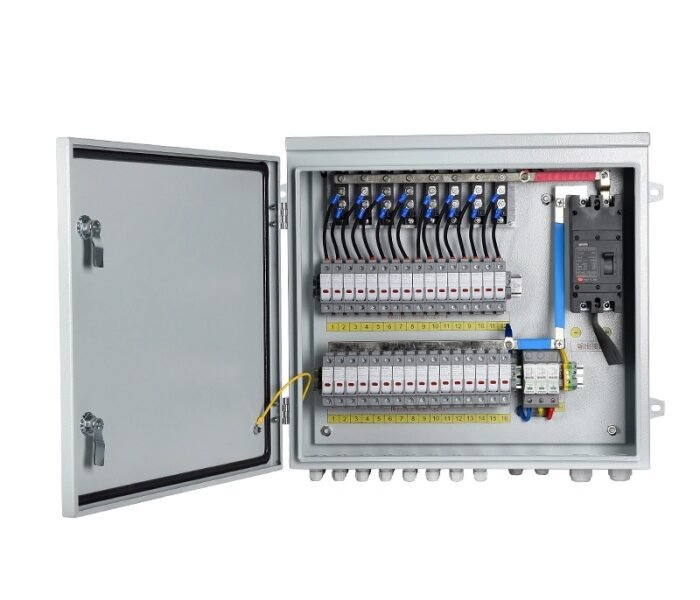
Every commercial solar plant ends at the same point: the grid-connected cabinet where the inverter AC output meets the utility network. Getting this cabinet wrong can mean failed grid inspection, nuisance tripping, expensive rework or, worst case, an islanding event that injures line workers. This guide walks through the protection, metering and anti-islanding requirements for a 2026 PV grid-connected cabinet, with real sizing examples and a selection checklist you can hand to any switchgear supplier.
TL;DR: The Short Answer for Solar EPCs
- The grid-connected cabinet is the AC interface between inverters and the utility point of common coupling (PCC); it must handle protection, metering, isolation and surge protection.
- Size the main breaker by full inverter output current plus margin, not by array DC power alone; use the formula I = P / (1.732 x U x pf).
- Bidirectional metering with 0.5S CTs is mandatory for net metering or feed-in tariff projects in most countries.
- Anti-islanding is primarily an inverter function (IEEE 1547 / IEC 62116), but the cabinet must provide an external isolation and lockable disconnect point for utility safety rules.
- Order the cabinet with surge protection at both AC and DC sides, proper cable glanding, and a nameplate showing the grid code it complies with.
What the Grid-Connected Cabinet Actually Does
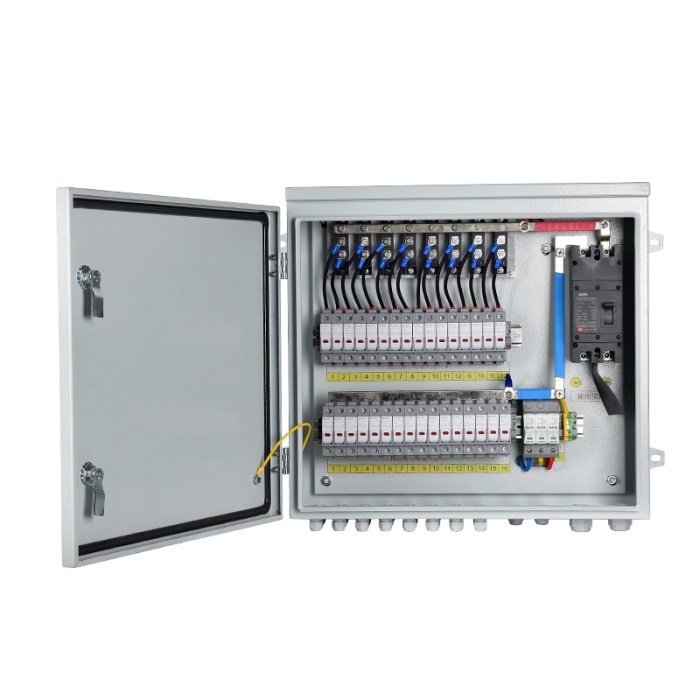
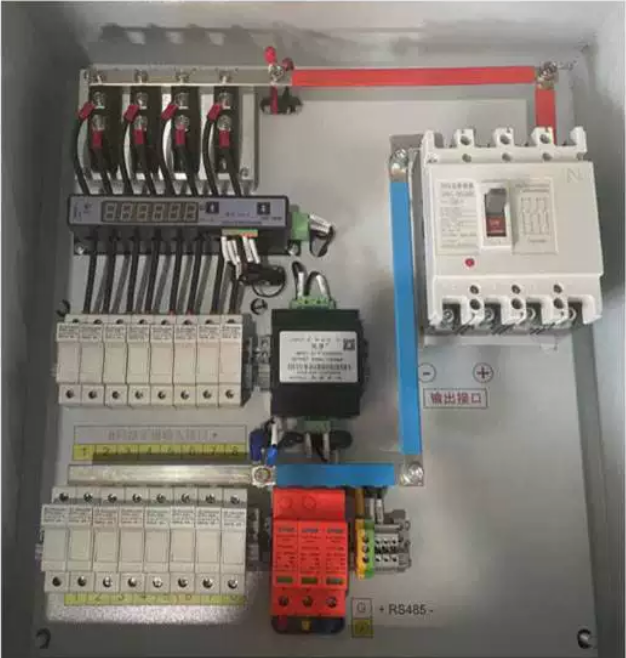
The PV grid-connected cabinet (sometimes called the AC combiner or metering cabinet) sits between the inverter AC terminals and the utility meter or PCC. It performs five jobs:
- Protection: a main AC circuit breaker (MCCB/ACB) with adequate short-circuit breaking capacity and a residual current device where required.
- Isolation: a lockable disconnect so utility workers can guarantee a dead circuit during maintenance.
- Metering: current transformers and terminal space for the utility’s bidirectional energy meter.
- Surge protection: type 2 SPDs on the AC side, and coordination with the DC-side SPDs in the combiner boxes.
- Monitoring: optional CT inputs for a gateway that reports generation and curtailment status.
Real Sizing Example: An 800kW Commercial Rooftop
Take an 800kW system on a 400V three-phase grid with four 200kW string inverters. Each inverter delivers roughly 200kW at unity power factor:
I = 200,000 W / (1.732 x 400 V x 1.0) = 289 A per inverter.
Four inverters feed the cabinet, so the common bus current is about 1,155 A. The main breaker should be rated at least 1,250 A frame, and because the inverter current is continuous, the breaker must be selected with the 80% continuous-load rule in mind: a 1,600 A breaker is the correct choice for a 1,155 A continuous load. The busbar should be rated 1,600 A with a temperature rise below the IEC 61439 limit. If the inverters operate at 0.8 power factor (some projects do), add 25% to the current: 1,155 A becomes 1,440 A and the 1,600 A selection is confirmed.
| System size (400V) | Approx. full-load current | Recommended main breaker | CT ratio |
|---|---|---|---|
| 100 kW | 144 A | 200 A MCCB | 200/5 |
| 250 kW | 361 A | 500 A MCCB | 500/5 |
| 500 kW | 722 A | 800 A MCCB / 1000 A ACB | 1000/5 |
| 800 kW | 1,155 A | 1600 A ACB | 1600/5 |
| 1,000 kW | 1,444 A | 1600 A ACB | 2000/5 |
Always confirm the short-circuit level at the PCC with the utility. A cabinet with 10kA Icu is common, but if the utility fault level is 25kA or higher you must specify a higher breaking capacity breaker or add a limiting impedance. Failing to match Icu is one of the most common reasons for grid inspection failure.
Metering and Anti-Islanding Requirements
Bidirectional Metering
For net metering, feed-in tariff or export-limited projects, the utility installs a bidirectional meter. The cabinet must provide the CTs (accuracy class 0.5S or 0.2S for large systems), a sealed meter compartment, and terminal blocks with adequate space. Ask the utility for their metering scheme drawing before ordering the cabinet – every utility has a preferred layout, and re-drilling a cabinet after delivery is expensive.
Anti-Islanding Coordination
Anti-islanding detection is performed by the inverter according to IEEE 1547 or IEC 62116 (passive and active methods). The cabinet supports this with a clearly marked, lockable disconnect that the utility can open to prove isolation. Some grid codes require an external relay or a breaker tripped by the inverter’s fail-safe contact. Confirm with your inverter manufacturer and the local utility which arrangement they accept before you order.
Surge Coordination
Type 2 SPDs in the AC cabinet protect downstream metering and inverter electronics from switching and lightning transients. They must coordinate with the Type 1/Type 2 SPDs in the DC combiner boxes: the energy let-through of the upstream SPD must not exceed the downstream withstand. Ask the supplier for the SPD coordination study or a statement of compliance with IEC 61643-11/12.
Seven-Point Selection Checklist for 2026
- Full-load current at minimum power factor – size busbar and breaker with margin.
- Short-circuit breaking capacity Icu at the PCC – ask the utility for the fault level.
- Metering CT accuracy and utility scheme – 0.5S CTs, sealed meter compartment.
- SPD type and coordination – Type 2 AC side, coordinated with DC side.
- Grid code compliance – IEEE 1547, IEC 61727 or local grid code on the nameplate.
- Enclosure rating – IP54 minimum for outdoor, IP31 for indoor; consider tropical ventilation.
- Serviceability – hinged doors, cable entry with glands, spare terminals, cable schedule drawing.
For the DC side of the same system, read our solar combiner box installation guide and the combiner box vs junction box comparison, and size the inverters correctly with our solar inverter sizing guide.
FAQ About PV Grid-Connected Cabinets
What is the difference between a PV combiner box and a grid-connected cabinet?
A combiner box works on the DC side, combining strings before the inverter. The grid-connected cabinet works on the AC side, between the inverter and the utility. Most plants need both.
Do I need a separate anti-islanding relay in the cabinet?
Only if your grid code or utility requires it. Modern inverters perform anti-islanding internally; the cabinet’s role is to provide lockable isolation and, where required, a fail-safe trip path.
What CT accuracy do I need for metering?
Class 0.5S is standard for commercial net metering. Large utility-scale plants may require 0.2S. Check the utility’s metering scheme.
Can the cabinet include the utility meter?
Usually the utility installs and seals their own meter. The cabinet provides the CTs, terminal space and a sealed compartment. Never pre-install a meter without utility approval.
What IP rating should the cabinet have?
Indoor installations: IP31. Outdoor installations: IP54 or higher, with adequate ventilation to keep internal temperature below the component ratings.
Does Electric-GS make PV grid-connected cabinets?
Yes. Electric-GS supplies PV grid-connected cabinets from 100A to 3200A with MCCB/ACB options, 0.5S CTs, Type 1/2 SPDs and IP54 enclosures, fully wired and tested before delivery. Contact info@electric-gs.com or WhatsApp +86 135 8897 8050 with your inverter list and we will size the cabinet for you. More solar products are listed on electricgs.com and electric-cn.com.
2 thoughts