
A vacuum circuit breaker rarely fails in a dramatic way. It simply stops interrupting. Contacts inside the vacuum bottle erode a fraction of a millimetre per operation until the day the breaker must clear a fault and the arc outlives the gap. VCB contact wear is the one failure mode you can measure long before that point.
What Contact Wear Really Is
Two contacts sit face to face in a sealed bottle at very low pressure. On opening, a metal vapour arc burns between them for a few milliseconds and melts a thin layer of copper-chrome alloy. Three things change as they erode:
- The gap grows, so the arc must stretch further before it extinguishes.
- Contact pressure falls, because the same spring now has less travel to work with.
- Resistance rises, so the joint runs hotter under normal load.
A 12 kV interrupter is typically rated for 10,000 to 30,000 mechanical operations, but electrical endurance is far shorter: often 50 to 100 full short-circuit interruptions. A breaker on a faulted feeder wears out years before one that only switches load.
Five Checks You Can Run Before Failure
1. The wear mark on the stem. Most interrupters carry a scribed line or coloured band on the moving stem. When the pin reaches that mark, the designed allowance is used up. Read it with the breaker open, never closed.
2. Overstroke, measured not guessed. Overstroke is the extra travel past first touch, and it is what keeps pressure alive. On a 12 kV indoor VCB it usually falls in a narrow band such as 3 to 5 mm. Losing 1 mm is a warning; losing 2 mm means the bottle is near its end.
3. Contact resistance in micro-ohms. A micro-ohmmeter across closed poles shows the health of the joint, not the arc. A rise above 1.5 times the factory reading, or a spread wider than 20 percent between phases, points to pitting or a weak spring.
4. Contact spring force. A tired spring looks exactly like worn contacts on a resistance test, so check force with a gauge before condemning the bottle.
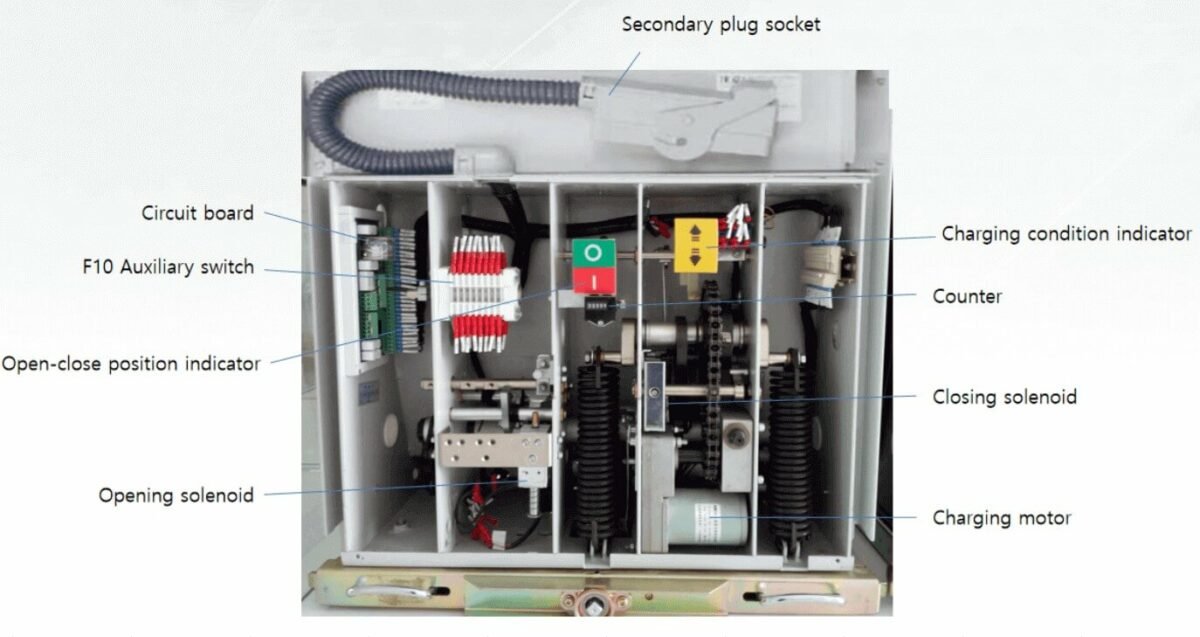
5. Trip and close coil current signature. A slow, low peak or a delayed latch release means friction is rising in the linkage, which usually means the mechanism no longer delivers full overstroke.
The Numbers That Tell You Where You Stand
These are the thresholds we apply on a 12 kV indoor VCB built for OEM panels:
| Check | Healthy | Warning | Replace |
|---|---|---|---|
| Wear mark | Clear of the line | Within 1 mm of line | Line reached |
| Overstroke | 3-5 mm, per maker | 1 mm below nominal | 2 mm below nominal |
| Contact resistance | Within 1.2x factory | 1.2-1.5x factory | Over 1.5x factory |
| Phase spread | Under 10 percent | 10-20 percent | Over 20 percent |
| Coil peak | Within 10 percent | 10-20 percent low | Over 20 percent low |
Confirm every band against the maker’s maintenance sheet. A 40 kA bottle and a 20 kA bottle do not wear at the same rate.
Electrical Tests That Confirm the Condition
- Power-frequency withstand on the open gap. A 42 kV test across an open 12 kV interrupter should hold. If the gap has eroded enough for field concentration, breakdown comes early.
- Vacuum integrity. A magnetron or voltage test across the open bottle detects lost vacuum, which a resistance test will not show.
- Timing. Opening and closing times plus phase simultaneity drifting past tolerance means the mechanism is compensating for worn contacts.
Why Lost Overstroke Fails First
Resistance climbs gradually; overstroke loss turns a slow problem into a sudden one. When the spring runs out of travel, pressure collapses and micro-asperities weld. The next high-current operation creates a hot spot, the contact face deforms, and the bottle loses its interrupting ability. By the time resistance looks alarming, the interrupter is usually past saving. Measure VCB contact wear at commissioning and record it, or a reading of 3 mm looks fine against a nominal of 5 mm.
When to Replace the Interrupter
Replace the bottle when the wear mark is reached or overstroke sits 2 mm below nominal, provided the mechanism and pole shell are sound. Replace the breaker when timing no longer repeats across three consecutive operations, or when vacuum is lost. Two notes from our assembly line: pair the poles, since one new bottle of three leaves phases with different travel; and re-commission with the same form used at first commissioning.
Inspection Mistakes That Create False Readings
- Reading resistance without cleaning the surfaces, so oxide film adds micro-ohms and looks like wear.
- Measuring overstroke with the breaker closed and latched, which hides the travel you want.
- Comparing phases only against each other, with no factory baseline; three equally worn poles look balanced.
- Trusting one test, when wear, spring force and vacuum are three separate failure modes.
For the surrounding checks, see our notes on temperature rise testing, nameplate ratings and fixed versus withdrawable designs. Racking a truck into a live section also depends on the interlock sequence being correct.
FAQ
How often should contact wear be checked?
At commissioning, then every two years or 2,000 operations. After any short-circuit interruption, check the wear mark before returning the breaker to service.
Can I judge wear from resistance alone?
No. Resistance reflects the joint, not the gap. A worn bottle with a clean, well-sprung joint can still read normal.
Is slight overstroke loss acceptable?
Within the maker’s tolerance, yes. Beyond 1 mm below nominal, plan replacement; beyond 2 mm, take the breaker out of service.
What does a low coil current peak mean?
Usually friction in the linkage or a weakening spring, not a failing coil. It warns you before resistance does.
Should all three poles be replaced together?
Yes. Mixed ages produce different travel and timing, which shows as uneven current sharing and nuisance trips.
Does a vacuum test replace mechanical checks?
No. Vacuum and VCB contact wear are independent failure modes; a bottle can hold vacuum with eroded contacts.


About Electric-GS. We build MV and LV switchgear, ring main units and vacuum circuit breakers in Yueqing, China, as an OEM/ODM factory. Send your single-line diagram, rated current and fault level, and we quote the breaker with its wear allowance and maintenance form. Email info@electric-gs.com or WhatsApp +86 135 8897 8050. Sister sites: electricgs.com and electric-cn.com.
Recent Comments