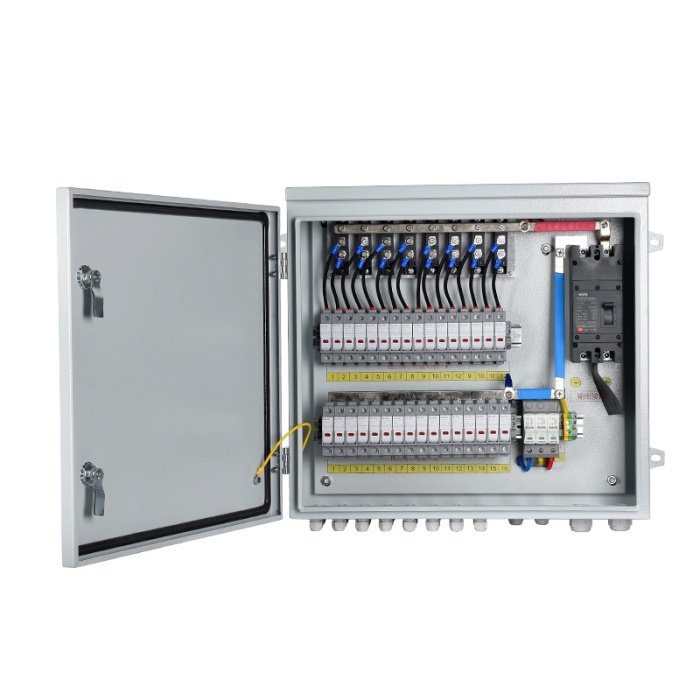
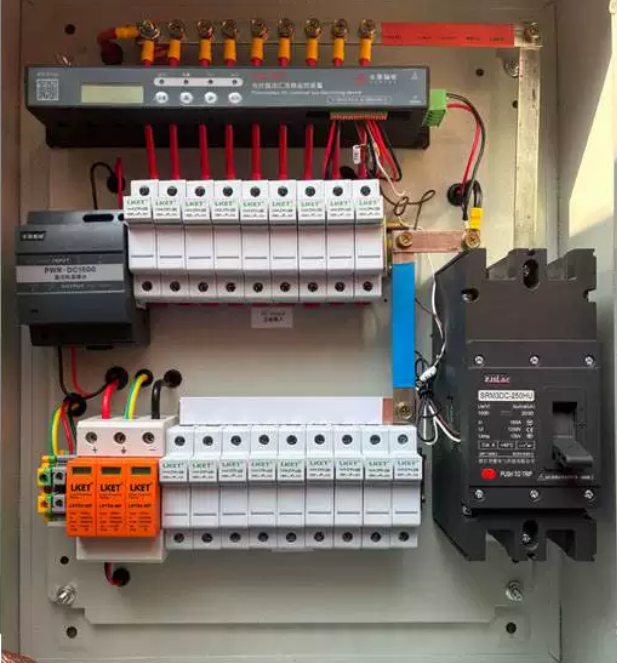
Many solar project owners ask: can’t I just use a regular distribution cabinet for my PV plant? The short answer is no. PV grid-connected cabinets are engineered specifically for the unique demands of grid-tied solar systems. This article explains the key differences.
Core Purpose Difference
A traditional distribution cabinet takes power from the grid and distributes it to loads. Power flows in one direction: from grid to consumer.
A PV grid-connected cabinet handles bi-directional power flow: solar inverters feed power into the grid, and the cabinet must safely manage both import and export.
Detailed Comparison
| Feature | Traditional Distribution Cabinet | PV Grid-Connected Cabinet |
|---|---|---|
| Power Flow | Unidirectional (grid → load) | Bi-directional (grid ↔ solar) |
| Protection Relay | Basic overcurrent only | Anti-islanding, OV/UV, OF/UF, vector surge |
| Metering | Unidirectional kWh | Bi-directional (import/export) |
| Surge Protection | AC SPD only | AC + DC SPD, Type 1+2 |
| Communication | Not required | RS485/Ethernet/4G for plant monitoring |
| Switching Device | Standard MCCB | Grid-rated switch with auxiliary contacts |
| Safety Features | Overcurrent protection | Anti-islanding, arc-flash, fault ride-through |
| Compliance | IEC 61439 | IEC 61439 + IEC 62109 + local grid code |
Why Anti-Islanding Protection Matters
When the utility grid goes down, your solar inverter must stop feeding power into the lines immediately. This is called anti-islanding protection. Without it, utility line workers could be electrocuted by back-fed solar power. Traditional distribution cabinets have no such protection.
Metering Differences
A traditional energy meter only measures power consumed from the grid. A PV grid cabinet requires a bi-directional meter that records both:
- Import: Power drawn from the grid at night or low irradiance
- Export: Power fed into the grid during peak solar production
This data is essential for net-metering billing and performance monitoring.
Surge Protection Requirements
Solar arrays are exposed to lightning and switching surges across long DC cable runs. PV grid cabinets must include:
- DC-side SPD on the inverter input
- AC-side SPD on the grid output
- Remote signalling contacts for SPD failure monitoring
Monitoring and Communication
Modern solar plants are remotely monitored. A PV grid cabinet typically includes:
- RS485 Modbus port for inverter communication
- Ethernet or 4G gateway for cloud monitoring
- Digital inputs for door status, smoke alarm, temperature
Cost Comparison
A PV grid-connected cabinet typically costs 30-50% more than an equivalent traditional distribution cabinet, due to the specialized protection relay, bi-directional metering and communication modules. However, this is a small fraction of total solar plant cost and is essential for grid compliance.
Frequently Asked Questions
Can I retrofit a traditional cabinet for PV use?
It is technically possible to add a grid-protection relay and bi-directional meter, but the internal layout, cable ratings and SPD placement may not meet standards. For safety and compliance, a purpose-built PV cabinet is recommended.
What happens if I use the wrong cabinet?
You risk: utility interconnection rejection, anti-islanding failure during grid outages, incorrect billing data, and potential safety hazards. Most utilities will not approve grid connection without certified PV switchgear.
Do off-grid systems need PV grid cabinets?
No. Off-grid systems use charge controllers and battery inverters without grid interconnection, so they do not require anti-islanding protection. A regular distribution panel is sufficient.
Are PV grid cabinets standardized?
Component types are standardized, but ratings and relay settings vary by country and utility. Every region has its own grid code (e.g., IEEE 1547 in the US, VDE-AR-N 4105 in Germany, GB/T 19964 in China).
How long does a PV grid cabinet last?
With proper maintenance, the enclosure and switchgear last 20+ years. SPDs should be checked every 2 years and replaced every 5 years or after a surge event.
About Electric-GS
Electric-GS is an experienced PV switchgear manufacturer in Yueqing, China. We supply grid-connected PV cabinets compliant with IEC, IEEE and GB standards for projects in Europe, Southeast Asia, the Middle East and Africa. Our engineering team helps you select the right protection settings for your local grid code. Email info@electric-gs.com or WhatsApp +86 135 8897 8050 for a customized solution.

For more electrical equipment options, visit our sister site electric-cn.com.
One thought