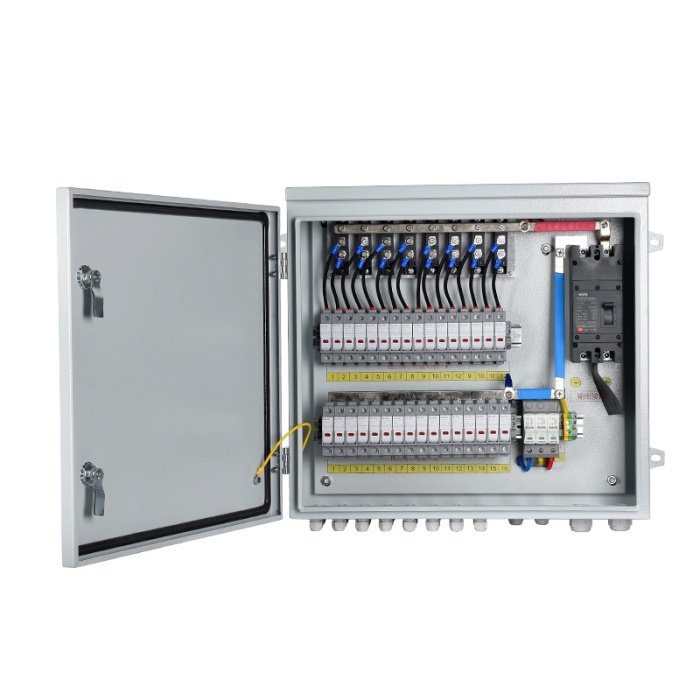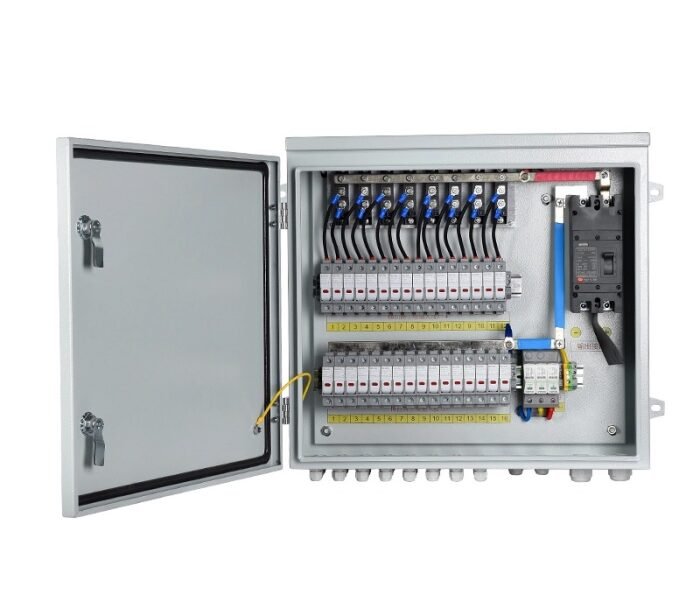
A PV combiner box is the small but critical junction between your solar strings and the inverter. When it fails, whole strings go offline and energy production drops. This PV combiner box troubleshooting guide covers the most common faults we see in the field, how to diagnose them safely, and the fixes that keep solar plants running. The same protection logic applies to solar PV grid-connected cabinet protection and wiring standards.
1. Blown DC Fuses in the Combiner Box
Blown fuses are the number one reason for lost strings. A fuse trips when current exceeds the rated value, usually because of a short circuit, a failed module, or reverse connection during maintenance.
How to diagnose
- Check the fuse indicator lamp on each circuit.
- Measure string voltage at the fuse holder with a DC clamp meter.
- Compare string currents; a zero reading means an open circuit.
How to fix
Replace the fuse with the same rating and type (gPV or equivalent). Never upgrade the fuse rating to stop tripping; the fuse protects the cable and the modules. If fuses blow repeatedly, inspect the string for a grounded module or water ingress.
2. Reverse Polarity Connection
Reverse polarity happens when string positive and negative cables are swapped, or when a module is connected backwards. It causes immediate fuse blowing and can damage blocking diodes and the inverter input stage.
- Always verify polarity with a multimeter before energizing.
- Use color-coded cables (red positive, black negative).
- Label every string at the box entry point.
3. Overheating Terminals and Loose Connections
Loose terminals are a fire risk. High resistance at a connection creates heat, which oxidizes the contact surface and raises resistance even more. Thermal imaging is the fastest way to find hot spots.
| Check | Tool | Frequency |
|---|---|---|
| Torque of terminal screws | Torque wrench | Every 6 months |
| Contact temperature | Thermal camera | Quarterly |
| Visual oxidation check | Eye inspection | Every visit |
Apply the correct torque per the terminal datasheet. A typical M6 copper terminal requires 8 to 10 Nm. Re-torque after the first thermal cycle.
4. Surge and Lightning Damage
Lightning strikes near the array induce high voltage surges that travel down the DC cables into the combiner box. Surge protection devices (SPD) inside the box are the first line of defense.
- Verify the SPD status window is still green.
- Replace SPDs after a nearby lightning event.
- Check that the box earth connection is below 4 ohms.
5. Water Ingress and Corrosion
Condensation and rain ingress cause corrosion on busbars, terminals and PCBs. Symptoms are intermittent faults, green corrosion on copper, and failed insulation resistance tests.
- Check the IP rating of the enclosure matches the site.
- Inspect cable glands and gaskets every season.
- Add desiccant bags for high humidity sites.
6. Communication Faults (Monitoring System Offline)
Many combiner boxes include string monitoring with RS485 or WiFi. When communication drops, check the daisy-chain wiring, termination resistors and the power supply of the monitoring unit. A short on the RS485 bus takes down the whole chain.
7. Wrong String Configuration and Mismatch
Strings with different module counts or orientations connected to one combiner cause mismatch losses. Each string should have the same number of modules, same tilt and same orientation to keep voltage and current balanced.
8. Fuse Rating and Cable Sizing Errors
Undersized cables and oversized fuses defeat the protection. Follow the Isc × 1.56 derating rule for fuse selection and size cables for the short-circuit current, not just the nominal current. More guidance is in our PV combiner box sizing and wiring best practices article.
9. Preventive Maintenance Checklist
- Torque check all terminals twice a year.
- Thermal scan of box and cables quarterly.
- Function test of SPD and fuse indicators.
- Insulation resistance test at 1000 V DC.
- Replace desiccant and check gaskets.
FAQ
1. Why does one string show zero current?
Usually a blown fuse, an open module connector, or a disconnected string cable. Measure at the fuse holder to isolate the cause.
2. Can I use a higher rated fuse to stop tripping?
No. The fuse protects the cable and modules. Use the correct rating and find the root cause of the trip.
3. How often should I inspect a PV combiner box?
Visual inspection every visit, torque and thermal checks every 6 months, full electrical tests once a year.
4. What is the correct torque for combiner terminals?
Typically 8 to 10 Nm for M6 copper terminals. Always follow the terminal datasheet.
5. Do combiner boxes need SPDs?
Yes. DC SPDs are essential in areas with thunderstorms and are recommended in all installations per IEC 62305.
6. Why does my monitoring show intermittent faults?
Often water ingress, loose RS485 connections, or failing SPDs. Inspect glands, check the bus wiring and test the SPD status.
Preventive Maintenance for PV Combiner Boxes
Preventive maintenance keeps small faults from becoming string outages. Set up a maintenance schedule based on your site conditions: every 3 to 6 months for dusty or coastal sites, every 6 to 12 months for clean inland sites. Each visit should include a thermal scan of the combiner box interior, a torque check on the DC connections, and a functional test of the surge protection devices (SPDs). Replace SPDs at the end of their service life or after a nearby lightning event, even if the indicator still looks healthy.
Keep a maintenance log per combiner box with the string currents at commissioning, the tightening torque values, fuse ratings and any replaced components. Comparing current string readings with the commissioning values is the fastest way to spot a degrading module or a failing connection before it interrupts production. For sites with remote monitoring, set alarms for string current deviation above 10 percent so that faults are detected without a site visit.
When to Call a Professional
Some faults require specialist tools and training. Insulation resistance testing with a DC insulation tester, string voltage testing with an open circuit, and work inside an energized combiner box should be done by a qualified electrician following the site safety rules. Always isolate the inverter and open the DC disconnector before opening the box. If you are not sure about the fault, stop and call the system integrator rather than risking an arc fault or an electric shock.
About Electric-GS
Electric-GS is a professional medium and low voltage switchgear manufacturer based in Yueqing, China. We supply ring main units, GIS, vacuum circuit breakers, LV and MV switchgear, transformers, compact substations and solar distribution products as an OEM/ODM factory. For a quotation or technical support, email info@electric-gs.com or contact us on WhatsApp at +86 135 8897 8050. Visit our partner sites electricgs.com and electric-cn.com for more product information.
Related Reading
- Solar PV Grid-Connected Cabinet Protection and Wiring Standards
- PV Combiner Box Sizing and Wiring Best Practices
- PV Grid-Connected Cabinet Sizing Guide
- Solar Grid-Connected Cabinet Integration Overview