
Choosing the right circuit breaker operating mechanism is critical for reliable medium voltage switching. The operating mechanism stores energy, closes the contacts and trips the breaker when a fault occurs. If the mechanism fails, even a perfect vacuum interrupter cannot protect your network. This guide explains the spring, solenoid and magnetic vacuum circuit breaker operating mechanism types, compares them in a table, and helps you select the best option for your project.
Why the operating mechanism matters. An operating mechanism is the muscle of a breaker. It must close fast, hold the contacts firmly and release the trip at the right moment. Three factors matter most: closing speed, control method and contact holding force.
In a vacuum circuit breaker, the mechanism works together with the vacuum interrupter. It must move the moving contact quickly enough to keep the closing speed within limits, yet stop gently to avoid contact bounce. A good mechanism gives a long mechanical life and stable electrical performance. The table below summarizes the three main types.
- Spring mechanism: most common, independent of a power supply.
- Solenoid mechanism: fast, simple, but needs a DC power source.
- Magnetic latching mechanism: few parts, high reliability, energy efficient.
Spring Operating Mechanism
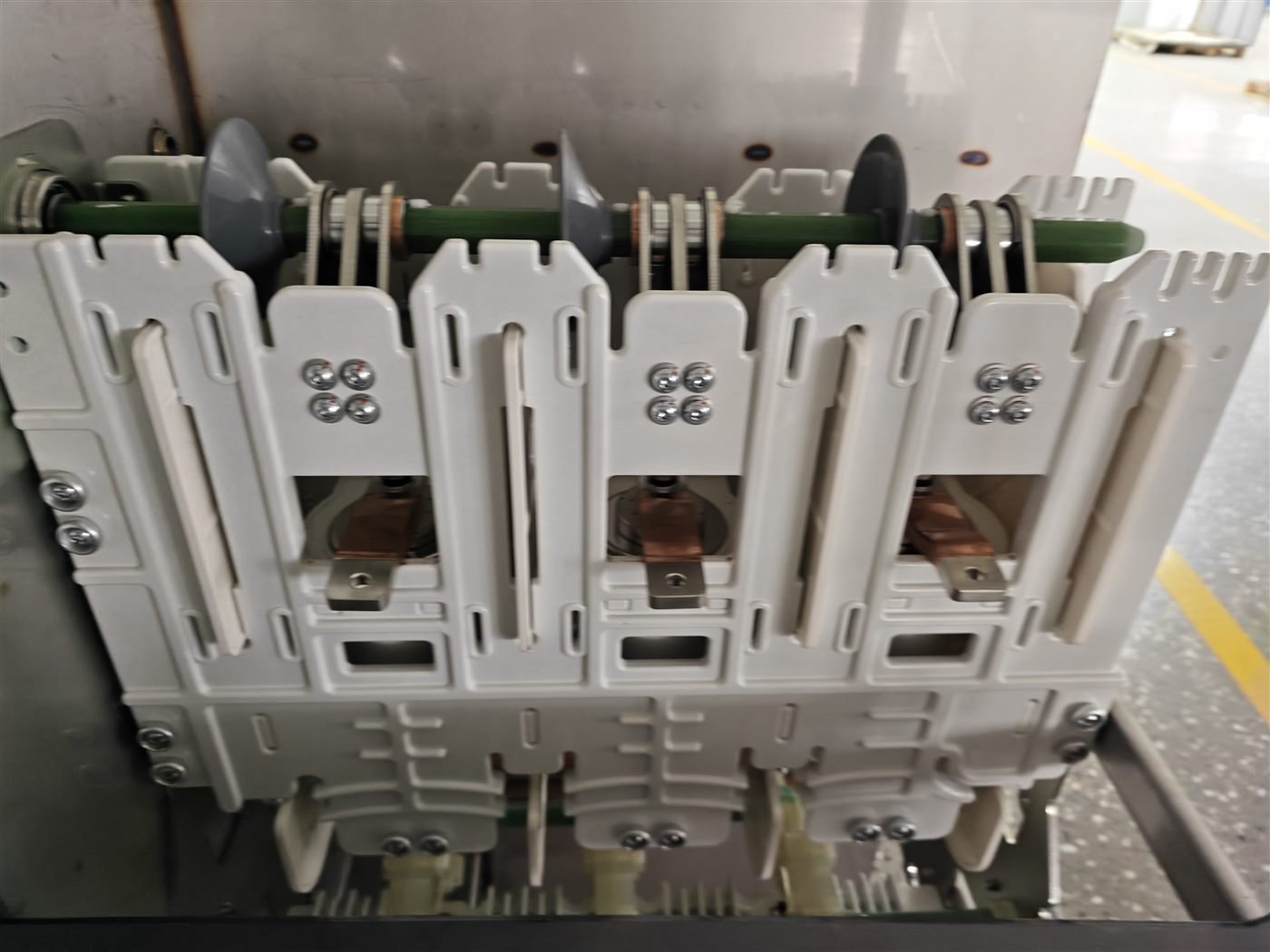
A spring mechanism stores energy in a charging spring. An electric motor or a manual handle charges the spring. When the breaker receives a close command, the spring releases and drives the contact system closed. A separate opening spring returns the contacts to the open position when tripped.
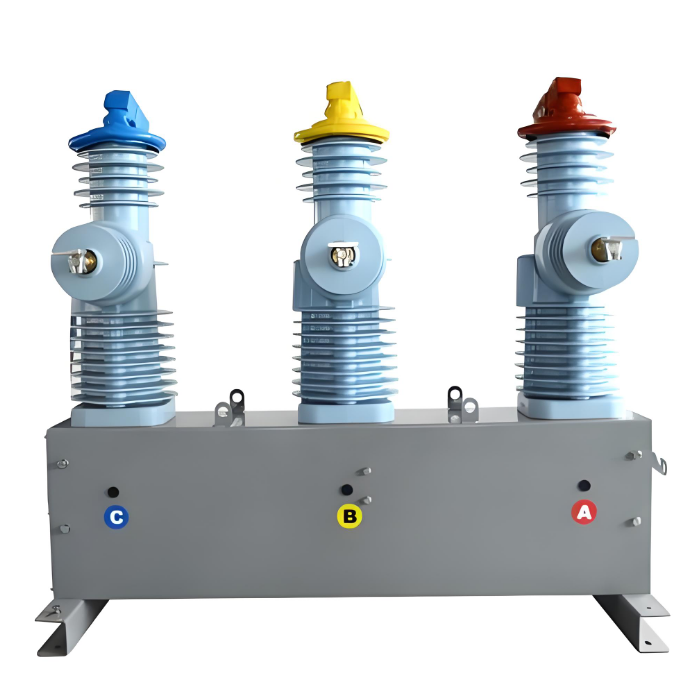
Spring mechanisms are self-contained. They do not need a continuous power supply to hold the closed position, so they keep the breaker closed even if the control voltage fails. This makes them the standard choice for most medium voltage panels, RMU cabinets and outdoor vacuum circuit breakers. For pole mounted outdoor designs, the pole mounted outdoor vacuum circuit breaker guide explains how the spring mechanism supports reliable operation in the field.
- Charged by motor or manual handle.
- Works without a continuous power supply.
- Wide range of closing energies.
- Slightly more moving parts than a magnetic mechanism.
Solenoid Operating Mechanism
A solenoid mechanism uses an electromagnet to move the contacts. When current flows through the coil, the magnetic field pulls the armature and closes the breaker. To release the trip, a second coil or a spring drives the contacts open.
Solenoid mechanisms are fast and simple. They have fewer mechanical parts than a spring mechanism and respond quickly to control signals. The main drawback is that they need a reliable DC control supply. If the DC supply fails, the breaker may not close. They are often used in compact switchgear where space is limited and a stable auxiliary supply is available.
- Fast closing action.
- Few moving parts.
- Requires a stable DC control source.
- Good for compact panels.
Magnetic (Magnetic Latching) Operating Mechanism
A magnetic latching mechanism uses a permanent magnet to hold the contacts in the closed position. A short current pulse closes the breaker, and a reverse pulse opens it. The permanent magnet holds the contacts without consuming power.
Because it uses very few moving parts, the magnetic mechanism gives high reliability and a long mechanical life. It is also energy efficient, because power is only needed for a short pulse. Magnetic mechanisms are increasingly used in solid insulated switchgear and advanced vacuum circuit breakers, where maintenance access is limited. To understand how the interrupter and mechanism combine, review the medium voltage vacuum circuit breaker ratings guide for the complete technical picture.
- Permanent magnet holds the closed position.
- Very few moving parts, long life.
- Energy efficient operation.
- Higher electronics requirement for the control circuit.
Comparison Table: Spring vs Solenoid vs Magnetic
| Feature | Spring | Solenoid | Magnetic Latching |
|---|---|---|---|
| Energy storage | Spring, motor charged | None, uses DC supply | Permanent magnet |
| Closing speed | Controllable | Fast | Fast |
| Power to hold closed | None | Continuous DC | None |
| Number of moving parts | Moderate | Low | Very low |
| Control circuit complexity | Low | Medium | Higher |
| Typical voltage range | All MV | LV and MV | MV, solid insulated |
| Typical cost | Low to medium | Medium | Higher |
How to Choose the Right Operating Mechanism
Follow these steps to choose the right vacuum circuit breaker operating mechanism for your network.
- Check whether a stable DC control supply is available on site.
- Count the number of operations expected over the breaker life.
- Review the available space inside the panel or pole mounted housing.
- Consider maintenance access and spare part availability.
- Match the closing energy to the contact mass and interrupter type.
- Compare total cost of ownership, not just the purchase price.
For most projects the spring mechanism is the safe, standard choice. If you need very long life and have a reliable control supply, a magnetic mechanism is attractive. Before deciding, read our top 10 vacuum circuit breaker selection tips and the comparison of vacuum and SF6 circuit breakers. For full product documentation, visit our global portal at electricgs.com or the Chinese portal at electric-cn.com.
Maintenance Tips for Operating Mechanisms
An operating mechanism needs regular inspection even though it is durable. Lubrication, contact wear checks and control circuit testing extend its life.
- Lubricate pivot points and moving links on schedule.
- Check contact wear and wipe distance during maintenance.
- Test close and trip operations at reduced control voltage.
- Inspect motor charging time and spring charge indicators.
- Verify auxiliary contacts and trip circuit health.
Add these checks to your routine. The medium voltage switchgear maintenance plan gives a step by step testing procedure you can reuse for every panel.
Frequently Asked Questions
What is a circuit breaker operating mechanism?
It is the mechanical system that stores energy, closes the contacts and trips the breaker. It works with the vacuum interrupter to interrupt current reliably.
Which vacuum circuit breaker operating mechanism is most common?
The spring operating mechanism is the most common. It is self-contained, does not need a continuous power supply and suits most medium voltage applications.
How long does a vacuum circuit breaker operating mechanism last?
A quality mechanism can handle 20,000 to 30,000 mechanical operations. Magnetic latching mechanisms often last longer because they have very few moving parts.
Does a solenoid mechanism need a continuous power supply?
Yes. A solenoid mechanism needs a reliable DC control supply to hold the closed position. If the DC supply fails, the breaker may not close.
Can a magnetic mechanism hold the breaker closed without power?
Yes. A permanent magnet holds the contacts closed without any power, which improves reliability and saves energy.
Is the operating mechanism maintenance free?
No. It still needs periodic lubrication, contact wear checks and control circuit testing as part of a switchgear maintenance program.
About Electric-GS
Electric-GS is a professional switchgear and vacuum circuit breaker manufacturer based in Yueqing, China. We offer OEM and ODM services for ring main units, medium voltage switchgear, vacuum circuit breakers, transformers and box substations, with strict quality control and global export experience. Contact us at info@electric-gs.com or WhatsApp +86 135 8897 8050 for a fast quotation.
One thought