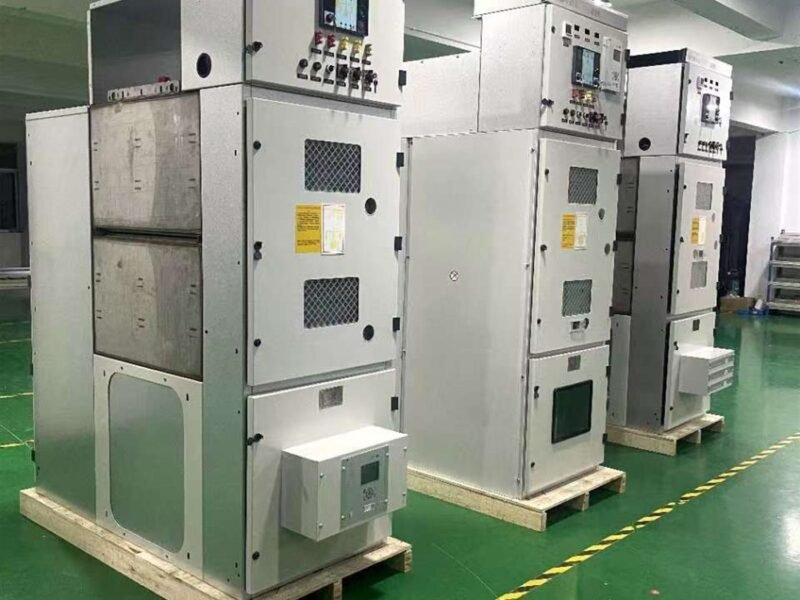
A battery container and a switchgear lineup are usually bought from different suppliers. The gap between them is where most energy storage sites fail their first commissioning test.
Energy storage switchgear has to do three jobs at once: carry current in both directions, protect a battery that cannot be switched off quickly, and survive a container roof in August.
What BESS Switchgear Has to Do Differently
A solar feeder only pushes power out. A storage feeder takes it in for hours, then reverses in milliseconds. That single difference changes the breaker, the relay settings and the cable.
- Bidirectional current: the breaker carries rated current in both directions, and the relay must know which direction is normal.
- Fast trip on fault: a battery keeps feeding a fault until the breaker opens, so clearing time matters more than selectivity margin.
- Isolation for service: a visible break and a lockable device are needed before anyone opens a DC bus or a module rack.
- Environment: condensation, dust and salt air attack the gear inside a container long before the battery shows any sign of trouble.
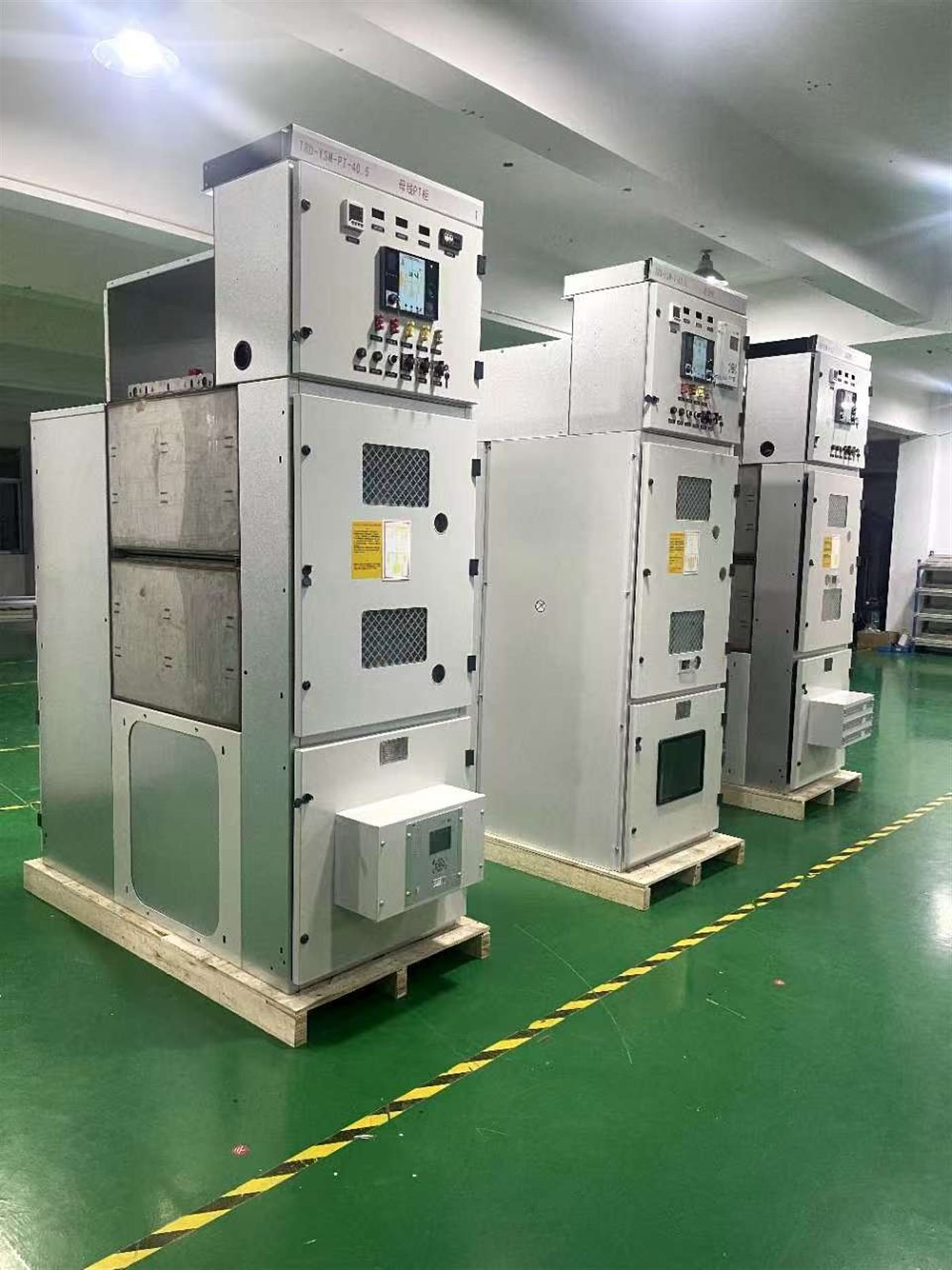
Point 1: Size for Charge and Discharge, Not Just Peak Output
Designers often size the feeder from the inverter datasheet. That is half the answer. A 2.5 MW inverter can draw close to its rated power from the grid during a charge cycle, and it does so for long periods.
- Continuous current: use the higher of charge and discharge current, then add ten percent for tolerance and ageing.
- Short-time rating: a one or two second overload is normal at the start of a discharge ramp, so check the breaker’s short-time withstand.
- Cable ampacity: derate for the container temperature and for cable grouping. A cable sized at 30 degrees will run hot at 50.
- Busbar: size the main bus for the sum of all containers, not for the current site layout, because the site will grow.
Our guide on medium voltage cable sizing walks through the derating factors that matter here.
Point 2: Choose the Voltage Level Deliberately
Small commercial cabinets can sit on the LV side. Anything above roughly 2 MW per container usually moves to MV, because the current at 400 V becomes unmanageable.
| Item | LV storage switchgear | MV storage switchgear |
|---|---|---|
| Typical voltage | 400 to 690 V | 11, 22 or 33 kV |
| Container size | Up to about 1 MW | 1 to 10 MW |
| Breaker type | MCCB or ACB | VCB or SF6 breaker |
| Current at 2 MW | About 2,900 A at 400 V | About 105 A at 11 kV |
| Cable size pressure | High, many parallel runs | Low, single feeder is enough |
| Protection | Thermal and overcurrent, simple settings | Directional and reverse power, richer settings |
| Best fit | C and I commercial sites, small microgrids | Utility-scale projects, co-located with PV |
Where the storage site also has a PV array, the two feeders often share a bus. Our solar PV switchgear guide covers the PV side of that arrangement, and the combiner box guide covers string level protection.
Point 3: Block Reverse Power and Islanding
When a container is charging, power flows from the grid into the battery. When the grid disappears, that flow must stop instantly, or the site backfeeds a dead line.
- Directional overcurrent set toward the grid, with a short definite time stage.
- Reverse power relay on each feeder, set below the smallest credible export.
- Anti-islanding handled by the inverter and confirmed by a relay, not by one device alone.
- Transfer trip or underfrequency load shedding for sites the utility watches closely.
- Breaker failure protection that trips the upstream device if the local breaker does not open.
Settings for these functions are covered in our protection relay guide. Write them into the relay file, not only into a spreadsheet.
Point 4: Handle Heat, Humidity and Salt
The gear lives beside the battery, so it inherits the container climate. Three details decide whether it lasts ten years:
- Condensation: anti condensation heaters on the busbar compartment, switched by a thermostat, not left on all year.
- Ingress: at least IP54 for the enclosure in coastal sites, with gaskets rated for the local temperature swing.
- Corrosion: hot dip galvanized or painted steel with a salt spray rating stated by the supplier, not just “anti corrosion”.
- Ventilation: a pressure relief path for the arc products, sized so a fault does not blow the container doors open.
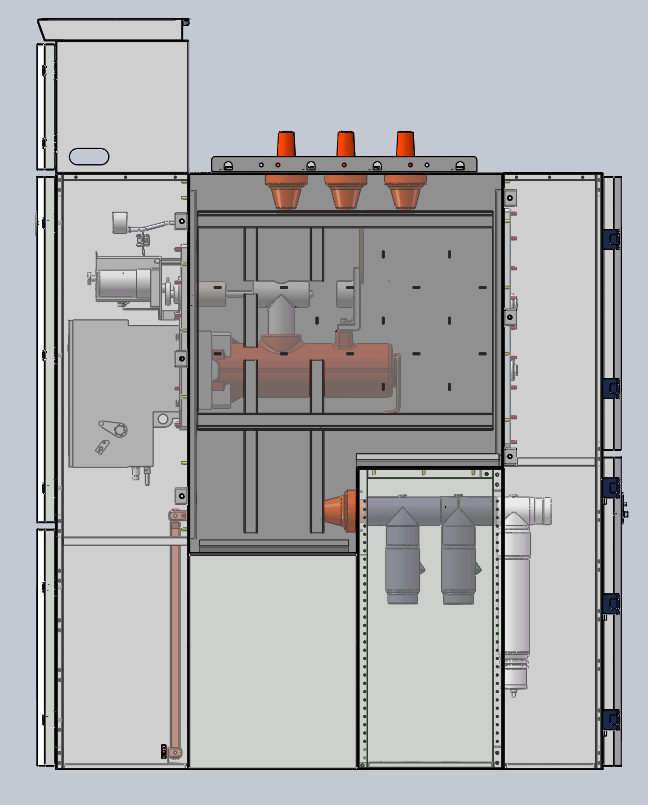
Point 5: Test and Commission Before Energizing
Commissioning is the only chance to prove the site can stop a fault before the battery is live:
- Insulation resistance and contact resistance on every feeder, recorded panel by panel.
- Relay injection for each protection function, including the directional element.
- Interlock test: the earthing switch must not close while the breaker is closed.
- Function test of the container stop, fire alarm trip and remote shutdown path.
- First charge at reduced rate, with current and temperature logged for the first hour.
The sequence in our MV switchgear testing guide can be followed almost unchanged, with the battery replaced by a resistive load for the first run.
Frequently Asked Questions
Can I use standard switchgear for a battery container?
Often yes, if the current rating covers charge and discharge, the relay has directional elements and the enclosure suits the climate. The settings, not the hardware, are usually what fails.
Why does the breaker need a higher short-time rating?
A battery maintains fault current for as long as it stays connected. The breaker must hold and then clear that current without damage to the contacts.
Do I need MV switchgear above 2 MW?
Above about 2 MW per container the LV current becomes impractical: cable bundles, busbar size and heat all grow faster than cost allows. MV is usually cheaper by then.
How do I stop backfeeding during an outage?
Use anti-islanding in the inverter plus a directional or reverse power relay, and confirm both operate in the commissioning test.
Is IP54 enough for a coastal container?
IP54 handles dust and spray, but salt fog needs a corrosion specification on top: coating system, galvanizing thickness and a stated salt spray hours figure.
How long does commissioning take?
For a four-container site, plan two to three days for switchgear tests and relay injection, plus one day for the first controlled charge.
Electric-GS builds ring main units, gas insulated and air insulated switchgear, vacuum circuit breakers and LV distribution boards in Yueqing, China, for OEM and ODM projects. Every panel is tested before dispatch, and we can supply container-ready lineups with the protection settings documented. Write to info@electric-gs.com or message WhatsApp +86 135 8897 8050. More references are on electricgs.com and electric-cn.com.