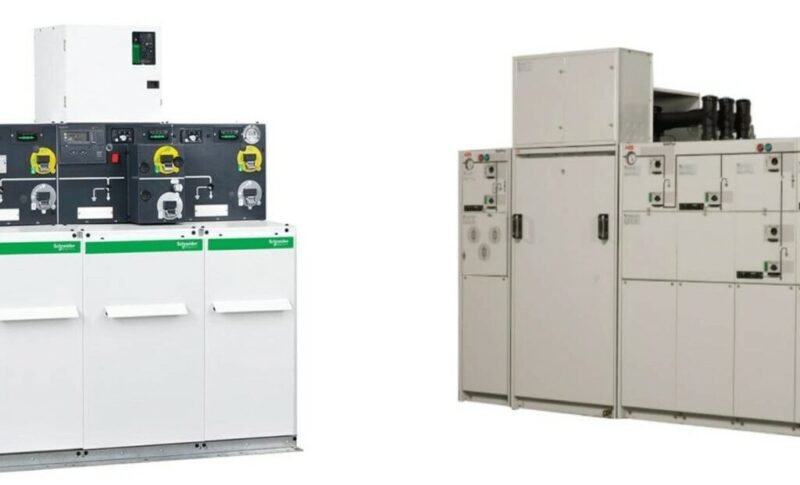
Ring main units (RMUs) come in two main insulation technologies: gas insulated (GIS-type) and air insulated (AIS-type). Both protect medium voltage distribution networks, but they differ in size, safety, maintenance, and lifetime cost. This complete comparison helps you choose the right ring main unit for your project.
What Is a Gas Insulated RMU?
A gas insulated RMU uses SF6 gas to insulate the busbars, load break switches, and earthing switches inside a sealed enclosure. Because SF6 has excellent dielectric strength, the unit can be very compact. Gas insulated RMUs are widely used in urban substations, underground vaults, and commercial buildings where space is limited.
What Is an Air Insulated RMU?
An air insulated RMU uses atmospheric air as the insulation medium. The live parts are separated by air gaps and enclosed in a metal cabinet. Air insulated RMUs are simpler, lower in first cost, and easier to service, making them popular for rural networks and industrial sites with plenty of space.
Head-to-Head Comparison Table
| Feature | Gas Insulated RMU | Air Insulated RMU |
|---|---|---|
| Insulation medium | SF6 gas, sealed compartment | Air, open to atmosphere |
| Footprint | Compact, up to 60% smaller | Larger, needs more clearance |
| First cost | Higher | Lower |
| Maintenance | Low, sealed for life | Regular inspection and cleaning |
| Environment | SF6 is a greenhouse gas | No special gas handling |
| Safety | Arc contained inside sealed tank | Arc venting via pressure relief |
| Typical use | Urban, indoor, underground | Rural, industrial, outdoor |
Size and Installation Differences
The biggest practical difference is size. A gas insulated RMU can be installed in a small room, a basement, or even a street-side kiosk because the SF6 gas provides excellent insulation in a fraction of the space. Air insulated RMUs need more room for air clearances, which increases the switchroom footprint and can raise the civil construction cost.
Safety and Arc Containment
Gas insulated RMUs contain the switching arc inside the sealed SF6 tank. This gives very high personnel safety and allows operation in tight spaces. Air insulated RMUs rely on pressure relief flaps and proper clearances to manage an internal arc. Both designs can meet arc fault test standards, but the gas design offers a higher level of containment.
Maintenance and Lifetime Cost
Gas insulated RMUs are essentially maintenance-free for the sealed gas compartments, although the gas pressure should be monitored. Air insulated RMUs require periodic cleaning of insulators, retorquing of connections, and inspection of the visible live parts. Over a 25-year life, the total ownership cost can be close, even though the gas unit costs more upfront.
Environmental Considerations
SF6 gas has a very high global warming potential, so regulators are pushing utilities to reduce leaks and consider alternative gases. Air insulated RMUs have no such concern. Some manufacturers now offer SF6-free gas insulated RMUs using dry air or fluoronitrile mixtures, which combine compactness with a lower environmental impact.
How to Choose: Gas or Air Insulated RMU?
- Choose gas insulated RMU for compact substations, basements, and urban vaults.
- Choose air insulated RMU for open-air yards, industrial plants, and budget-sensitive rural projects.
- Consider environmental regulations on SF6 in your region.
- Compare the total cost of ownership, not just the purchase price.
- Verify the rated short-circuit withstand and load current against your network.
For the technology background and selection rules, read our 12kV RMU selection guide. If you are deciding between RMU and conventional switchgear panels, the RMU vs traditional switchgear article explains the network-level trade-offs.
Switching and Operating Features
Both gas insulated and air insulated RMUs provide load break capability, earthing switches, and fault indication, but the operating mechanism differs. Gas insulated units use a sealed three-position switch that combines closed, open, and earthed states in one mechanism, giving a very compact and interlocked layout. Air insulated units often use separate switch disconnectors and earthing switches, which are simpler to inspect visually.
For fault protection, both types can be fitted with fuse protection on the transformer feeder or with a breaker for cable feeder applications. The choice depends on the transformer size and the protection philosophy of the network operator. Larger transformers generally require a circuit breaker, while smaller units can rely on high-voltage fuses.
Standards and Type Tests
Ring main units are type-tested to IEC 62271-200 for AC metal-enclosed switchgear, and the switching devices follow IEC 62271-103 or IEC 62271-105. Key type tests include internal arc classification (IAC), short-circuit making and breaking tests, and mechanical endurance. When comparing gas and air insulated RMUs, ask the supplier for the type test certificates and the specific test laboratory.
Frequently Asked Questions
1. Is a gas insulated RMU safe to install indoors?
Yes. The SF6 compartment is sealed, and the enclosure is tested to contain internal arcs. Indoor installation is one of the main applications for gas insulated RMUs.
2. How long does SF6 gas last in an RMU?
Under normal operation, the sealed compartment holds its pressure for the life of the unit, typically 25 years or more. The pressure gauge should still be checked during annual inspections.
3. Can air insulated RMUs be used outdoors?
Yes, with the correct IP rating and weather protection. Outdoor air insulated RMUs are common in rural distribution networks.
4. Which type is cheaper?
Air insulated RMUs have a lower first cost. Gas insulated RMUs may offer lower installation and civil costs when space is expensive.
5. Are there SF6-free gas insulated RMUs?
Yes. Several manufacturers offer SF6-free solutions using dry air or eco-friendly gas mixtures, and the trend is growing as environmental rules tighten.
6. Where can I buy a reliable RMU?
Electric-GS supplies both gas insulated and air insulated RMUs as an OEM/ODM manufacturer. For installation practice, see our top 10 RMU installation mistakes guide.
About Electric-GS
Electric-GS is a professional switchgear factory in Yueqing, China, manufacturing ring main units, gas insulated switchgear, vacuum circuit breakers, and LV/MV switchgear. For quotations and technical support, email info@electric-gs.com or contact WhatsApp +86 135 8897 8050. Visit electricgs.com and electric-cn.com for more product lines.
Related Reading
- Gas Insulated Switchgear Installation and Commissioning Guide
- Top 10 Ring Main Unit Installation Mistakes to Avoid
- 12kV RMU Selection Guide


6 thoughts