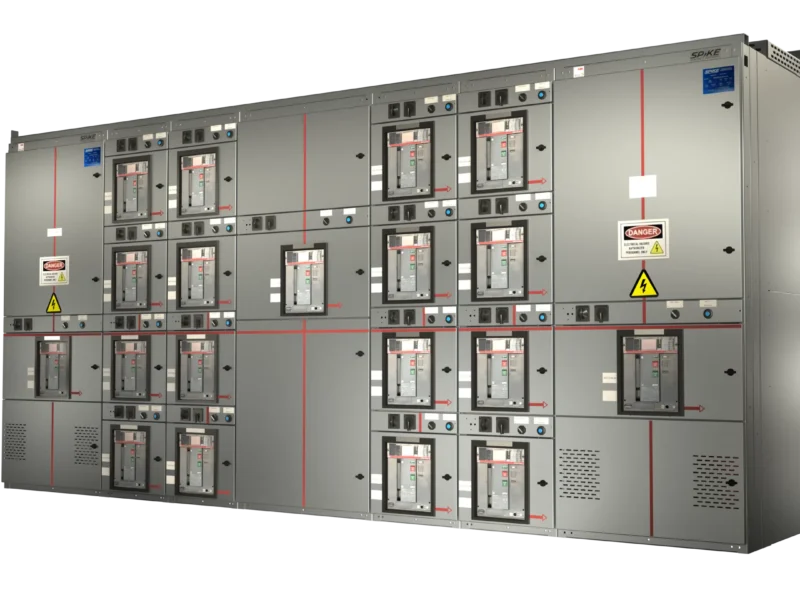
Switchgear is the backbone of every power distribution system, but low voltage (LV) and medium voltage (MV) switchgear serve very different roles. Engineers, plant managers, and buyers often ask which type they need. This guide explains the key differences between low voltage switchgear and medium voltage switchgear, including voltage ranges, components, applications, and selection criteria.
Voltage Range: The Primary Difference
The most fundamental difference is the operating voltage. Low voltage switchgear operates at up to 1,000 V AC, while medium voltage switchgear covers 3.3 kV to 36 kV, with 12 kV and 24 kV being the most common levels in distribution networks. This difference drives everything else: insulation design, arc quenching method, and component selection.
Key Components of LV vs MV Switchgear
| Feature | Low Voltage Switchgear | Medium Voltage Switchgear |
|---|---|---|
| Voltage range | Up to 1,000 V AC | 3.3 kV to 36 kV |
| Main switching device | Molded case circuit breaker, AC contactor | Vacuum circuit breaker, SF6 breaker, load break switch |
| Arc quenching | Air or magnetic blowout | Vacuum or SF6 gas |
| Insulation | Air insulation, IP30-IP54 enclosures | Air, SF6, or solid insulation systems |
| Protection relay | Simple thermal-magnetic or electronic trip | Numerical protection relay with communication |
| Standards | IEC 61439, GB/T 7251 | IEC 62271, GB/T 3906 |
How Each Type Is Used
Low Voltage Switchgear Applications
LV switchgear distributes power within a building, factory, or plant after the step-down transformer. It feeds motors, lighting, HVAC systems, and small machinery. Typical configurations include main distribution boards, motor control centres (MCCs), and final distribution panels. See our guide to low voltage switchgear applications for real-world examples.
Medium Voltage Switchgear Applications
MV switchgear controls power at the substation level. It receives power from the utility or a generator, protects transformers and feeders, and supplies the LV switchgear through distribution transformers. MV panels are found in utility substations, industrial plants, wind farms, and data centres.
Design and Construction Differences
MV switchgear requires much more attention to insulation distance, arc containment, and busbar support. Drawout circuit breakers, interlocking systems, and arc-resistant construction are common in MV designs. LV switchgear is simpler, more compact, and easier to maintain, but it must still meet the temperature rise and short-circuit withstand requirements of IEC 61439.
Short-Circuit Ratings
Short-circuit current is another major difference. A large MV switchgear installation may need a rated short-time withstand current of 25 kA or 31.5 kA for 3 seconds. LV switchgear ratings are typically given as short-circuit breaking capacity in kA, and the enclosure must withstand the associated arc effects. Always check the system fault level before choosing a panel.
Protection and Control
Medium voltage switchgear uses numerical protection relays that measure current, voltage, and frequency, and communicate over IEC 61850 or Modbus. Low voltage switchgear relies on circuit breaker trip units, contactors, and overload relays. The protection philosophy is different because MV faults have much higher energy and must be cleared faster.
Cost and Maintenance Considerations
MV switchgear is significantly more expensive per panel than LV switchgear. Maintenance is also more specialised, requiring trained technicians, test equipment, and in some cases SF6 gas handling procedures. LV switchgear can often be maintained by in-house electrical staff with basic tools. This cost difference is justified by the higher safety and reliability requirements at medium voltage levels.
How to Choose Between LV and MV Switchgear
- Determine the supply voltage and the load voltage of your plant.
- Check the utility connection point and meter voltage.
- Calculate the total load and the expected fault level.
- Consider future expansion and the space available in the switchroom.
- Review local regulations and grid connection requirements.
For a deeper look at panel design, read our low voltage switchgear design guide. If your project involves MV testing, the medium voltage switchgear testing and commissioning guide covers the full acceptance procedure.
Standards and Compliance for LV and MV Switchgear
Low voltage switchgear assemblies must comply with IEC 61439, which covers design verification, temperature rise limits, and short-circuit withstand. Medium voltage switchgear follows IEC 62271, with separate parts for circuit breakers, switch-disconnectors, and busbar systems. In China, GB/T 7251 and GB/T 3906 mirror these international standards, so products certified for either system are usually accepted in most markets.
Compliance is not just about the standard number on the nameplate. Ask the manufacturer for routine test reports and design verification evidence. A reputable OEM factory like Electric-GS can provide the full documentation package for each panel.
Space and Installation Requirements
LV switchgear is compact and can be installed against a wall in most cases, with maintenance access from the front. MV switchgear needs more clearance: busbar chambers, cable compartments, and arc relief vents must have the prescribed distances, and the switchroom often requires special ventilation and fire barriers. When planning a new plant, factor these space differences into the building layout from the start.
Frequently Asked Questions
1. Can low voltage switchgear be used at medium voltage?
No. LV switchgear is not designed for medium voltage insulation or interruption duties. Using it at MV would create a serious safety hazard.
2. What voltage is considered medium voltage?
Medium voltage generally means 3.3 kV to 36 kV in distribution practice. Some countries also use 1 kV to 72.5 kV as a broader MV definition.
3. Is medium voltage switchgear safer than low voltage switchgear?
MV switchgear is designed with arc-resistant enclosures, interlocks, and remote operation to manage the higher energy of MV faults. When properly specified and maintained, both types are safe for their intended applications.
4. Which is more expensive, LV or MV switchgear?
MV switchgear is substantially more expensive per unit because of vacuum breakers, numerical relays, and heavier construction. The total installed cost depends on the number of panels and the protection scheme.
5. Can the same switchroom house both LV and MV panels?
Yes, but they must be segregated by distance or barriers according to the switchroom standards, and access control and cable routing must follow the separation rules.
6. Does Electric-GS manufacture both LV and MV switchgear?
Yes. Electric-GS produces both low voltage and medium voltage switchgear, including metal-clad and metal-enclosed designs. Compare the two constructions in our metal clad vs metal enclosed switchgear article.
About Electric-GS
Electric-GS is a professional LV and MV switchgear manufacturer in Yueqing, China, supplying distribution equipment to projects worldwide as an OEM/ODM partner. Email info@electric-gs.com or WhatsApp +86 135 8897 8050 for quotations. Find more products at electricgs.com and electric-cn.com.
Related Reading
- Medium Voltage Switchgear Trends 2026
- Metal Clad vs Metal Enclosed Switchgear
- Gas Insulated Switchgear Installation Guide

3 thoughts