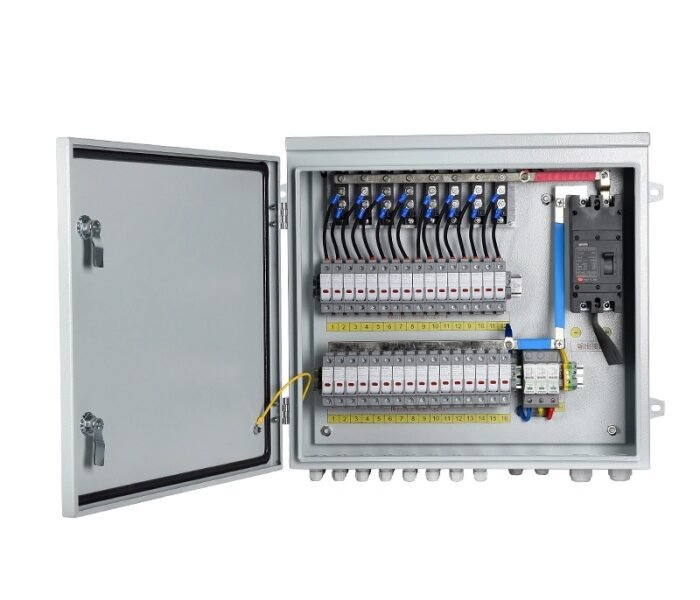
A solar combiner box is one of the most important parts of a photovoltaic (PV) system. It gathers the DC output of many strings into one safe, serviceable point. A well-sized combiner box reduces cable cost, improves safety, and makes maintenance faster. This guide explains what a solar combiner box does, how to size it, and how to protect your solar plant.
What Is a Solar Combiner Box?
A solar combiner box collects the DC output from multiple PV strings and combines them into a single conductor before they reach the inverter. Each string enters through a fuse holder, and the box sums the current onto one output busbar. The unit also carries surge protection, a DC disconnect switch, and terminal blocks for easy service.
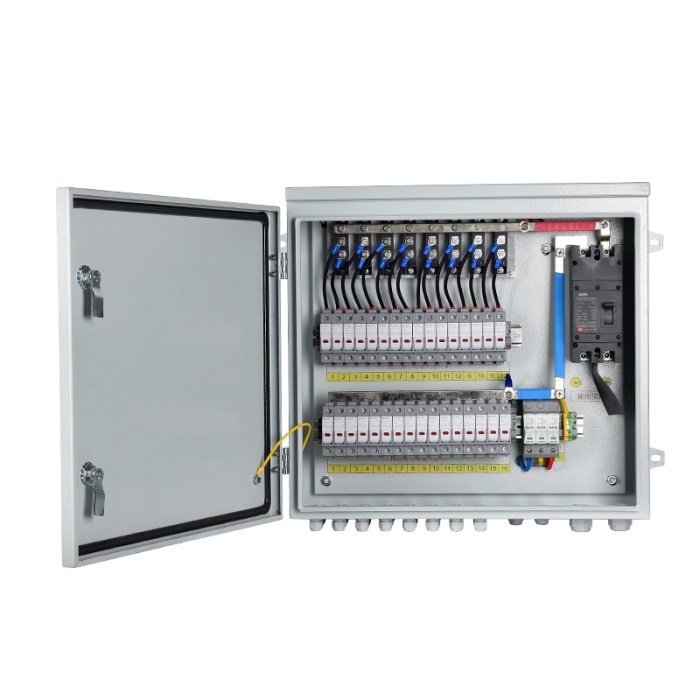
The main job is to create one safe collection point for the whole array. Instead of running every string cable all the way to the inverter, you run one short cable from each string to the box, then a single heavy cable to the inverter. This saves copper, shortens cable routes, and keeps the array neat. The box is usually installed close to the array on the roof or on the ground beside the structure.
Key Components of a Solar Combiner Box
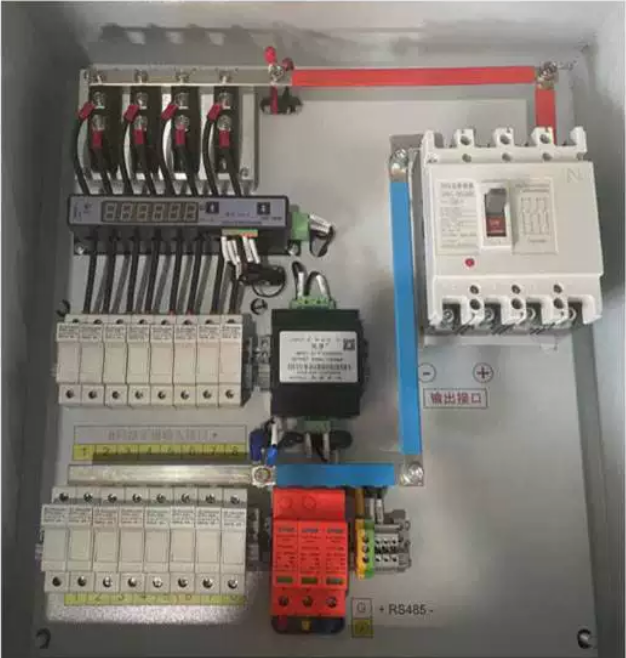
A standard solar combiner box contains a small set of proven parts. Each part has a clear role in safety and performance.
- Input fuse holders – protect each PV string from reverse current and overload.
- DC busbar – connects all string outputs to one point.
- Surge protective device (SPD) – clamps lightning and switching surges.
- DC disconnect switch – allows safe isolation during maintenance.
- Output terminal – the single conductor that runs to the inverter.
- Optional monitoring – current and voltage sensors for remote data.
Choose parts rated for the DC voltage and current of your array. A low rating is the most common cause of failure, so always leave margin. For more on the switchgear family around the plant, see our solar PV switchgear guide.
Solar Combiner Box Sizing: 8 Tips That Save You Money
Correct sizing prevents overheating, nuisance tripping, and costly rework. Follow these eight tips before you order.
- Count your strings first. The number of strings sets the number of fuse slots you need. Add spare slots for future expansion.
- Match the fuse to the cable. The fuse rating must protect the smallest cable in the string circuit, not just carry the current.
- Check the busbar rating. Sum all string currents and compare with the busbar rated current. The busbar must carry the total.
- Choose the correct voltage class. Most systems use 600 V, 1000 V, or 1500 V DC. Match the box to the inverter input voltage.
- Leave spare input slots. Solar plants grow. A spare slot avoids a full re-purchase later.
- Consider the IP rating. Outdoor boxes need at least IP65 to block rain and dust.
- Plan for monitoring. If you want string-level data, choose a box with a monitoring module now.
- Buy from a tested OEM. A factory-tested unit with type-test reports is safer than an unbranded import.
When the array feeds a bigger plant, the combined output often connects to a low-voltage switchgear panel or a compact substation that steps the power for grid connection.
String current and voltage limits. Read the module nameplate for the short-circuit current and the open-circuit voltage. Multiply them by the number of modules in the string and the number of strings in parallel. The combiner box rating must sit above these values with at least 25% margin.
Conductor and fuse ratings. The output cable must carry the summed current of every string. The main fuse must protect that cable. Do not oversize the fuse to avoid trips; that leaves the cable unprotected. Calculate, then confirm with the manufacturer.
Protection and Safety Design
Safety comes from four layers inside the box. First, every string has its own fuse. Second, the SPD diverts surge energy to earth. Third, the DC disconnect creates a visible break for maintenance. Fourth, a proper earth connection ties the enclosure to the plant ground. Together these layers stop fire risk and protect technicians. Always follow the local code for DC installations.
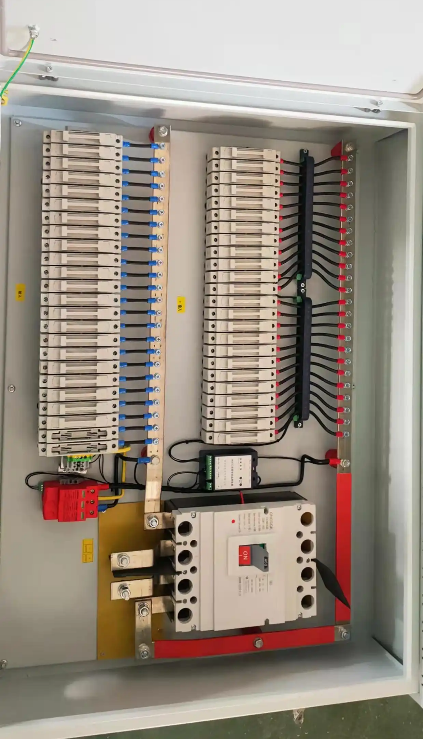
Combiner Box vs DC Junction Box: Comparison Table
| Feature | Solar Combiner Box | DC Junction Box |
|---|---|---|
| Main job | Combine strings, fuse and switch | Join cables only |
| Fuses per string | Yes | Usually no |
| Surge protection | Yes | Optional |
| Disconnect switch | Yes | No |
| Best use | Large PV arrays | Small or simple connections |
Installation and Maintenance Best Practices
Install the box away from direct heat and standing water. Keep the lid closed except during service. Torque every terminal to the specified value. Schedule a yearly check: inspect fuses, measure string currents, test the SPD indicator, and clean dust from the enclosure. Log the readings so you can spot a weak string early. For the wider plant, a ring main unit often protects the medium-voltage side of the transformer.
FAQ About Solar Combiner Boxes
Q1. What is a solar combiner box used for?
It combines the DC output of many PV strings into one point, with fuses, surge protection and a disconnect switch for safe operation.
Q2. How do I size a solar combiner box?
Count the strings, sum the currents, add 25% margin, and choose a box with the right voltage class, fuse slots and busbar rating.
Q3. Is a combiner box the same as a junction box?
No. A combiner box adds fusing, surge protection and a disconnect. A junction box only joins cables.
Q4. Which voltage class should I pick?
Match the inverter input. Most systems use 600 V, 1000 V or 1500 V DC. Confirm with the inverter datasheet.
Q5. Do I need surge protection in the combiner box?
Yes for large arrays. An SPD clamps lightning and switching surges and protects the inverter and cables.
Q6. How often should I service the box?
Once a year. Inspect fuses, torque terminals, test the SPD, and measure each string current.
About Electric-GS
Electric-GS is a Chinese OEM and ODM manufacturer based in Yueqing, Zhejiang. We design and build solar combiner boxes, switchgear, ring main units and transformers with type-test reports and factory testing. For pricing and drawings, email info@electric-gs.com or reach us on WhatsApp at +86 135 8897 8050. Our range also covers related products; see our main site at electricgs.com and our domestic catalog at electric-cn.com.
Recent Comments