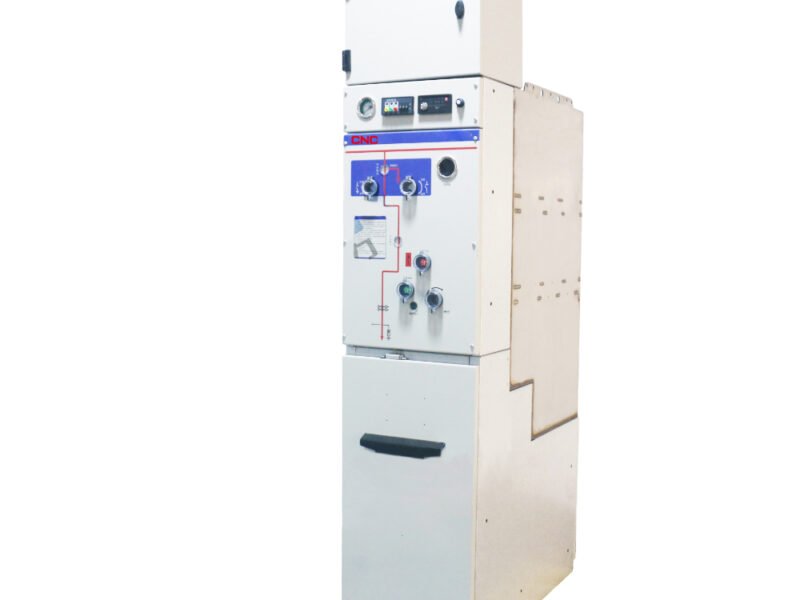
If you are buying a ring main unit in 2026, the biggest decision is no longer voltage rating or fault level. It is the insulation technology. The European F-gas Regulation (EU) 2024/573 is now forcing the industry away from SF6, and the same pressure is arriving in Southeast Asia, the Middle East and Latin America through utility tender requirements. This guide compares the three insulation technologies used in modern RMUs – SF6, solid insulation and clean air – with real numbers, cold-climate behaviour and a 10-year lifecycle cost model you can use in your next tender.
TL;DR: The Short Answer for Busy Engineers
- SF6 RMU: lowest first cost, proven over 30 years, best for extreme cold (-40°C), but subject to tightening regulation and gas management duties.
- Solid insulated RMU: zero gas, zero pressure monitoring, compact, ideal for urban and high-humidity sites; slightly heavier and costlier to expand or repair.
- Clean air RMU: GWP-free, close to SF6 performance, larger footprint, higher first cost; the strongest choice for EU-tendered projects and green-certified buildings.
- Recommendation: for most 12-24kV distribution projects outside the EU, solid insulated RMU offers the best balance of environmental compliance, reliability and total cost. If your site hits -25°C or below, or your tender requires proven seismic performance, SF6 remains defensible today.
Why This Decision Is Changing in 2026
SF6 has a global warming potential (GWP) of 25,200 – one kilogram of SF6 equals 25.2 tonnes of CO2. Regulation (EU) 2024/573 phases out SF6 in new medium voltage switchgear: from 2026, equipment up to 24kV with voltage > 24kV and breaking capacity > 17.5kA is restricted (with exemptions for specific applications), and the no-SF6 requirement extends through 2028-2032 for almost all new MV switchgear in the EU market.
Even outside Europe, utilities in the Gulf, Singapore, Australia and Latin America are adding “SF6-free” or “low GWP” clauses to tenders because their EPC contractors already buy EU-compliant equipment and want one common specification. If you sell switchgear internationally, you need to know exactly what each technology costs you over a decade – not just at purchase.

How the Three Insulation Technologies Actually Differ
SF6 Insulation
SF6 gas fills the sealed tank at roughly 0.03-0.05 MPa gauge. The gas’s electronegativity gives excellent arc-quenching and dielectric strength – about 2.5 times air for the same clearance. Because the tank is factory-sealed and maintenance-free, SF6 RMUs tolerate dust, salt and humidity that would destroy air-insulated gear. The operating mechanism has no gas-related duty, and the unit can be fully buried or pad-mounted.
Solid Insulation (Epoxy Cast)
Solid insulated RMUs cast the busbars, switch poles and cable terminations in epoxy resin. There is no gas, no pressure vessel and no density relay. The insulation performance is stable from -40°C to +55°C ambient without any gas management. The design is compact and the enclosure can be fully sealed, which is why solid insulated RMUs are popular in flooded basements, coastal installations and polluted industrial zones.
Clean Air (Dry Air / N2)
Clean air RMUs use dried air or nitrogen at a slightly higher pressure (around 0.14 MPa) to recover the dielectric strength lost by removing SF6. Performance is close to SF6 for 12-24kV, but the tank is physically larger and the pressure must be monitored with a density gauge, so it is not fully maintenance-free. First cost is 10-20% above an equivalent SF6 unit.

Cold Climate and Altitude: The Hidden Differentiator
This is where most buyers make mistakes. SF6 liquefies at around -40°C at operating pressure, which is why SF6 RMUs are rated to -25°C or -40°C depending on the gas filling. Solid insulated RMUs have no gas to condense, so their low-temperature limit is set by the operating mechanism and gaskets – typically -40°C without derating.
At altitude above 1000m, air density drops and the dielectric strength of both SF6 (insignificantly) and air (noticeably) decreases. Solid insulation is effectively altitude-independent. For a 3000m mining project in Peru or Tibet, solid insulated RMU avoids a large derating factor that would otherwise force a bigger, more expensive unit.
| Parameter | SF6 RMU | Solid RMU | Clean Air RMU |
|---|---|---|---|
| GWP of insulating medium | 25,200 | 0 | 0 (air) / ~0 (N2) |
| Typical first cost (12kV, 3-way) | USD 1.0x (baseline) | USD 1.05-1.15x | USD 1.10-1.20x |
| Footprint | Compact | Compact | +10-20% |
| Gas pressure monitoring | Density relay | None | Density gauge |
| Low temp limit | -25 / -40°C | -40°C | -25 / -40°C |
| Altitude derating | Minimal | None | Significant >2000m |
| Maintenance | Gas check + operation test | Operation test only | Pressure check + operation test |
| End-of-life | Gas recovery required | Recyclable resin | Simple gas release |
| EU 2024/573 compliance | Restricted from 2026-2032 | Compliant | Compliant |
Real 10-Year Lifecycle Cost Model
Use this model for a 12kV, 3-way RMU installed in a humid coastal city (ambient max 40°C, no extreme cold). Figures are indicative 2026 prices; adjust with your local labour and energy rates.
| Cost Item | SF6 RMU | Solid RMU | Clean Air RMU |
|---|---|---|---|
| Purchase price | $8,000 | $9,000 | $9,600 |
| Installation | $800 | $800 | $850 |
| Yearly inspection (10 yrs) | $2,000 | $1,200 | $1,800 |
| SF6 gas top-up / leak repair | $500 | $0 | $100 |
| Training & compliance paperwork | $800 | $200 | $400 |
| End-of-life decommission | $1,200 | $400 | $300 |
| 10-year total | $13,300 | $11,600 | $13,050 |
In this model the solid insulated RMU saves about USD 1,700 over ten years versus SF6, mostly from zero gas management and lighter inspections. Clean air ends up almost identical to SF6 once you add the larger footprint and pressure monitoring. The result changes if your site is at -30°C or your utility mandates SF6-free: then clean air or solid wins by regulation, not by cost.

Maintenance Reality: What Your Team Will Actually Do
- SF6: quarterly density relay check (visual), annual operation test, SF6 handling training for staff, leak records, gas recovery planning at end of life.
- Solid: annual operation test and visual check of enclosures and cable connections. No gas-related paperwork at all.
- Clean air: quarterly pressure gauge reading, annual operation test, and the same envelope care as SF6 because the tank is still a pressure vessel.
For utilities with limited technician training, the solid option removes an entire class of maintenance failures (gas leaks, density relay faults, incorrect top-up). This is a decisive advantage in remote or rotating-staff environments. Before any live work on any RMU, follow the correct switching sequence in our RMU operation guide, and terminate cables to the standard described in our RMU cable termination best practices.
A Practical Selection Framework for Your Project
- Is your tender EU-funded or EU-spec? – Choose solid or clean air; SF6 will be non-compliant.
- Does site temperature drop below -25°C? – Solid or SF6; check clean air derating carefully.
- Is the site above 2000m altitude? – Solid is the safest choice.
- Is the site coastal, flooded or dusty? – Solid or SF6 (sealed); avoid air-insulated.
- Is your maintenance team small or remote? – Solid reduces gas duties.
- Is first cost the only constraint? – SF6, with a documented gas management plan.
- Do you need to expand bays later? – All three expand, but solid RMUs may require factory modification for some designs; confirm with the manufacturer.
FAQ About SF6-Free RMU Technology
Is SF6 still allowed in RMUs?
Yes, outside the EU and for existing installations worldwide. In the EU, new MV switchgear above certain ratings is restricted from 2026 with almost complete phase-out by 2032. Many other markets still accept SF6, but SF6-free is increasingly written into tender specifications.
Is solid insulated RMU reliable?
Yes. Epoxy-cast insulation has been used in transformers, busbars and switchgear for decades. The main design care points are thermal expansion management, partial discharge control and cable termination quality, all covered by type tests.
Can a solid insulated RMU be repaired after a fault?
Partial faults can be repaired by replacing the affected module. Severe internal faults may require returning the module to the factory, so keep a spare module for critical installations.
What is the typical lifetime of an SF6-free RMU?
All three technologies are designed for 25-30 years. Solid insulated units have no gas to replenish, so their life is mainly limited by mechanism wear and connector condition.
Does clean air RMU need more space?
Yes, typically 10-20% more footprint than SF6 or solid for the same rating, because the lower dielectric strength requires larger clearances or higher gas pressure.
Does Electric-GS manufacture all three types?
Yes. We produce the GSG2 solid insulated RMU, the GSRM6 SF6-insulated RMU and the GSM6 air-insulated RMU from 12kV to 24kV, all with optional remote monitoring. For a detailed comparison sheet and drawings, contact us at info@electric-gs.com or WhatsApp +86 135 8897 8050.
For a wider view of when RMU versus full switchgear is appropriate, see our RMU vs switchgear comparison, and for outdoor station integration, our compact substation guide.
About Electric-GS
Electric-GS is a professional OEM/ODM switchgear factory in Yueqing, Zhejiang, China, manufacturing SF6, solid insulated and air insulated ring main units, vacuum circuit breakers, transformers, LV/MV switchgear and solar power distribution equipment. All products are type-tested to IEC standards with routine tests on every unit. Request a quotation or a factory video inspection at info@electric-gs.com or WhatsApp +86 135 8897 8050. Our partner sites electricgs.com and electric-cn.com list the full product range.
One thought