
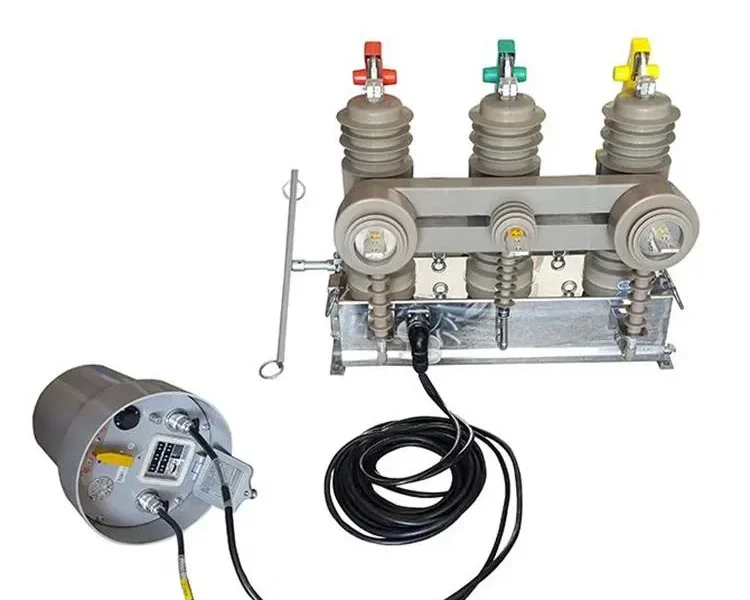
Development of Outdoor Circuit Breakers: From SF₆ to Vacuum Circuit Breakers
With the tightening of environmental regulations and advancements in technology, outdoor high-voltage circuit breakers are gradually transitioning from SF₆ circuit breakers to vacuum circuit breakers (VCB). This shift is driven by the following factors:
1. SF₆ Circuit Breakers (Sulfur Hexafluoride Circuit Breaker)
SF₆ circuit breakers have long been the mainstream choice for high-voltage applications due to their excellent arc-extinguishing and insulation properties, especially for voltage levels 66kV and above.
1.1 Advantages of SF₆ Circuit Breakers
✅ Superior arc-extinguishing performance: SF₆ gas has extremely high electronegativity, which allows it to quickly absorb free electrons and suppress arc reignition, ensuring stable breaking performance.
✅ High insulation strength: The dielectric strength of SF₆ gas is 2–3 times that of air, enabling compact designs while withstanding high voltage levels.
✅ Suitable for high-current, high-capacity systems: Particularly ideal for 110kV and above applications in power transmission and substations.
1.2 Disadvantages of SF₆ Circuit Breakers
❌ Environmental concerns: SF₆ is a highly potent greenhouse gas, with a global warming potential (GWP) 23,500 times greater than CO₂, making leakage a significant environmental issue.
❌ High maintenance requirements: Regular SF₆ gas leakage monitoring and refilling are necessary, increasing operational costs.
❌ Regulatory restrictions: Many countries, especially in Europe, are phasing out SF₆-based equipment and encouraging the development of SF₆-free alternatives.

2. Vacuum Circuit Breakers (VCB)
Vacuum circuit breakers utilize a vacuum chamber as the arc-extinguishing medium. Since there are no gas molecules in a vacuum, the arc cannot sustain itself, making this a highly effective breaking method.
2.1 Advantages of Vacuum Circuit Breakers
✅ Environmentally friendly: No SF₆ gas, no greenhouse gas emissions, and aligned with global sustainability trends.
✅ Low maintenance costs: The vacuum chamber requires no gas refilling, significantly reducing operational costs. Lifespan can reach up to 30 years.
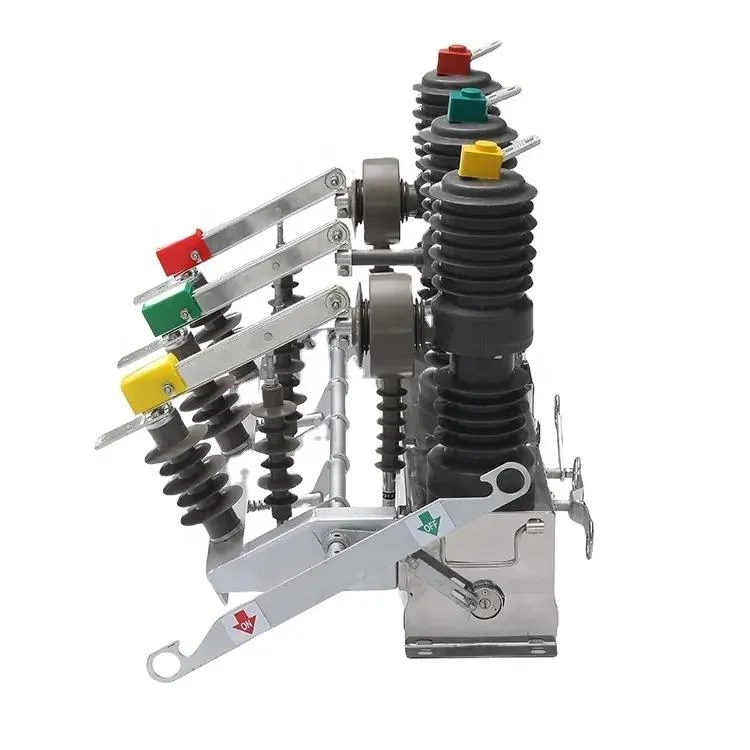
✅ Ideal for frequent switching operations: Suitable for industrial applications and urban distribution networks, covering 12kV to 40.5kV, with some manufacturers offering solutions for 72.5kV.
✅ Short arc-extinguishing time: Vacuum circuit breakers operate quickly, minimizing overvoltage and reducing system stress.
2.2 Disadvantages of Vacuum Circuit Breakers
❌ Limited arc-extinguishing capability: For voltage levels 110kV and above, vacuum circuit breakers face design constraints due to the breaking gap requirements.
❌ Transient Recovery Voltage (TRV) concerns: High TRV levels may require additional overvoltage suppression measures.
3. Market Trend: Transition from SF₆ to Vacuum and Solid Insulation Technologies
✅ For medium voltage distribution networks (12kV to 40.5kV), SF₆ circuit breakers are being replaced by vacuum circuit breakers, especially in factories, urban grids, and data centers.
✅ For high-voltage applications (66kV and above), SF₆ remains dominant, but SF₆-free solutions such as solid-insulated breakers (SIS) and mixed gas-insulated breakers (CO₂+O₂) are emerging.
✅ The power industry is actively developing SF₆-free technologies to meet carbon neutrality and sustainability goals.
4. Comparison of Suitable Applications
| Circuit Breaker Type | Voltage Level | Main Applications | Maintenance Needs | Environmental Impact |
|---|---|---|---|---|
| SF₆ Circuit Breaker | 12kV-110kV and above | Substations, high-current applications | Regular maintenance required | Greenhouse gas emissions |
| Vacuum Circuit Breaker (VCB) | 12kV-40.5kV (some up to 72.5kV) | Distribution networks, industrial users | Low maintenance | Eco-friendly, no pollution |
| Solid Insulated Circuit Breaker (SIS) | 12kV-24kV (some up to 40.5kV) | Urban grids, rail transit | Almost maintenance-free | Most eco-friendly, no gas emissions |
Conclusion:
For 12kV–40.5kV outdoor applications, vacuum circuit breakers have become the mainstream choice, gradually replacing SF₆ breakers.
For 66kV and above, SF₆ circuit breakers remain widely used, but the industry is actively exploring SF₆-free alternatives, such as solid insulation or mixed gas technologies.
If your project involves 12kV–40.5kV outdoor high-voltage equipment, vacuum circuit breakers are the preferred choice. For higher voltage applications, we can explore SF₆-free alternatives. What specific application or project are you considering?