
A 33kV vacuum circuit breaker is the main switching device in many medium voltage networks. It clears faults fast, needs little maintenance and can make thousands of operations. This guide explains the key ratings, switching duty, indoor and outdoor types and the selection points for a 33kV vacuum circuit breaker, so you can specify the right unit for your substation.
The decision matters because the breaker sits between the transformer, the busbar and the outgoing feeder. If it is undersized, it trips on normal overloads or fails to clear a real fault. If it is oversized, you pay for capacity you never use.
Why Choose a 33kV Vacuum Circuit Breaker
Vacuum circuit breakers dominate modern distribution because the contacts open inside a sealed vacuum bottle. The arc extinguishes quickly and cleanly, so the breaker stays compact and reliable. They also avoid oil and gas, which simplifies maintenance and makes them safer for indoor rooms.
The vacuum bottle removes the need for periodic oil changes or gas refills. Over a typical life of 10,000 to 30,000 operations, the unit needs almost no internal attention. That low upkeep is why utilities standardize on vacuum technology for new stations.
At 33kV these units are widely used for transformer feeders, capacitor banks, cable and overhead line circuits. Their long mechanical life and low service cost make them the default choice for new projects.
Key Ratings of a 33kV Vacuum Circuit Breaker
Every 33kV VCB carries a rating plate that defines its capability. Match each value to the network before you order.
| Parameter | Typical 33kV value | What it means |
|---|---|---|
| Rated voltage | 40.5kV / 36kV | Highest system voltage the unit can serve |
| Rated current | 630A to 2500A | Continuous load the breaker carries |
| Breaking capacity | 25kA to 31.5kA | Maximum fault current it can clear |
| Making capacity | Up to 2.5 x breaking | Peak current it can close onto |
| Short time current | 25kA / 3s | Through fault current for 3 seconds |
Confirm these values against the short circuit level of your substation and the transformer rating you plan to feed. A margin of about 10% above the calculated fault level is a safe practice, because the real fault can be higher than the design figure and the network may grow over time. Also check the number of operations the mechanism can make at rated current, so the unit lasts as long as the station.
Switching Duty and Load Classes
The breaker must handle more than steady current. It closes on to faults, breaks transformer inrush and switches capacitor banks with high re-strike risk. The standard defines duty classes such as E2 for electrical endurance and M2 for mechanical endurance. Choose a unit that matches the duty, not just the rated current.
For capacitor banks, ask about the class C2 capability and the making current rating. For transformers, confirm the unit can close and open repeatedly without degrading the vacuum bottles. For frequent daily operations, such as in a wind or solar plant, select a class M2 mechanism that survives hundreds of cycles a year. Co-ordinate the breaker with the protection relay so trips are fast and selective between feeders.

Indoor vs Outdoor 33kV Vacuum Circuit Breaker
The installation decides the enclosure and operating mechanism design.
- Indoor units mount in a switchgear panel with a withdrawable or fixed mechanism.
- Outdoor units come in a weatherproof pole mounted or pad mounted enclosure.
- Indoor models favor compact construction and easy access for maintenance.
- Outdoor models need sealed boxes and corrosion resistant coating for rain and dust.
- For remote sites, add motor operation and a control box.
Review the indoor vs outdoor switchgear choice before you finalize the enclosure and the panel layout. This single decision sets the enclosure class, the mechanism type and the whole cost of the bay.

How to Select a 33kV Vacuum Circuit Breaker
Follow this order to avoid a wrong match.
- Confirm the system voltage class and the short circuit level.
- Calculate the maximum continuous load and pick the rated current.
- Select the breaking and making capacity above the substation fault level.
- Choose the duty class for electrical and mechanical endurance.
- Decide indoor or outdoor, fixed or withdrawable, manual or motor.
- Check the control voltage, auxiliaries and communication options.
- Ask for type test certificates, a routine test report and a clear warranty.
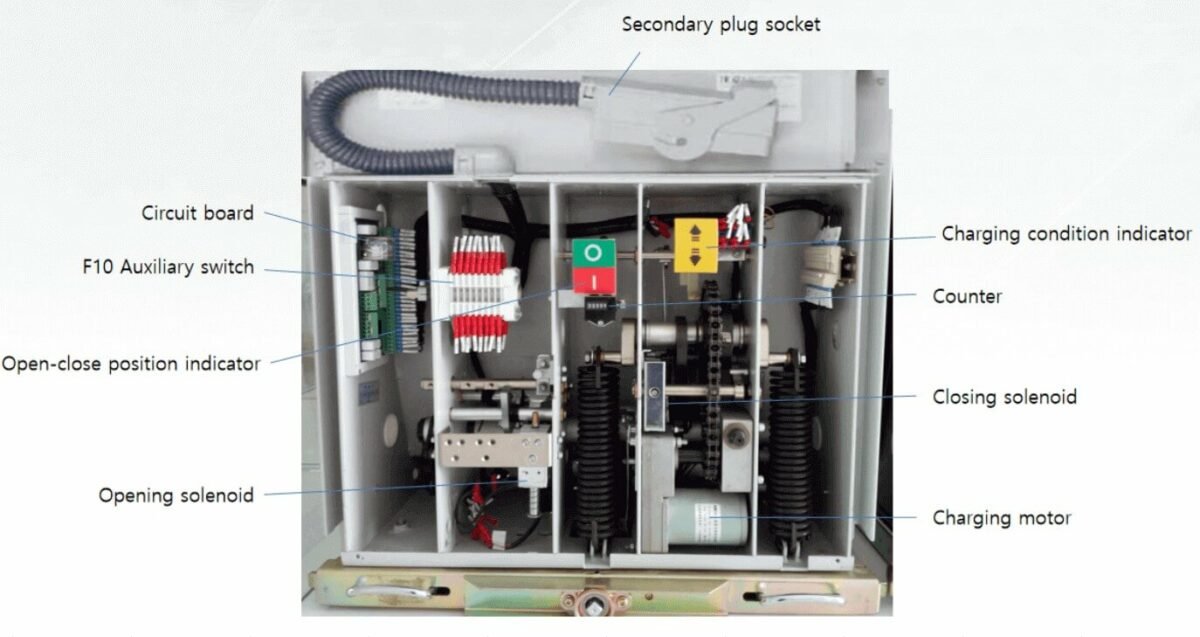
Before energization, run the correct medium voltage switchgear testing routine. For a full comparison with SF6 technology, read the SF6 vs vacuum circuit breaker guide, and review the VCB operating mechanism to understand how the unit trips and closes. For the surrounding station, see the ring main unit selection guide.
Frequently Asked Questions
What voltage class is a 33kV VCB?
A 33kV vacuum circuit breaker is usually rated 36kV or 40.5kV to give a safe margin above the 33kV system voltage.
What is the rated current of a 33kV VCB?
Most units are available from 630A up to 2500A, selected to carry the maximum continuous load without overheating.
What breaking capacity do I need?
Choose a breaking capacity above the short circuit level of the substation, commonly 25kA or 31.5kA at 33kV.
Can a 33kV VCB switch a capacitor bank?
Yes, but pick a class C2 unit designed for capacitor switching to avoid re-strike and overvoltages.
Indoor or outdoor 33kV VCB, which is better?
Indoor units suit switchgear rooms and are compact. Outdoor units suit pole or pad installations and need weatherproof enclosures.
Why ask for a type test certificate?
A type test certificate proves the breaker meets its rated voltage, current and fault ratings, so you can trust it in service.

About Electric-GS
Electric-GS is a professional electrical equipment manufacturer based in Yueqing, China. We offer OEM and ODM services for vacuum circuit breakers, ring main units, medium voltage switchgear and transformers, with full factory testing and global export experience. Every unit ships with a complete test report, and our engineers help you match the breaker to your network. Contact us at info@electric-gs.com or WhatsApp +86 135 8897 8050 for a fast quotation. Visit electricgs.com or the Chinese portal at electric-cn.com.
One thought