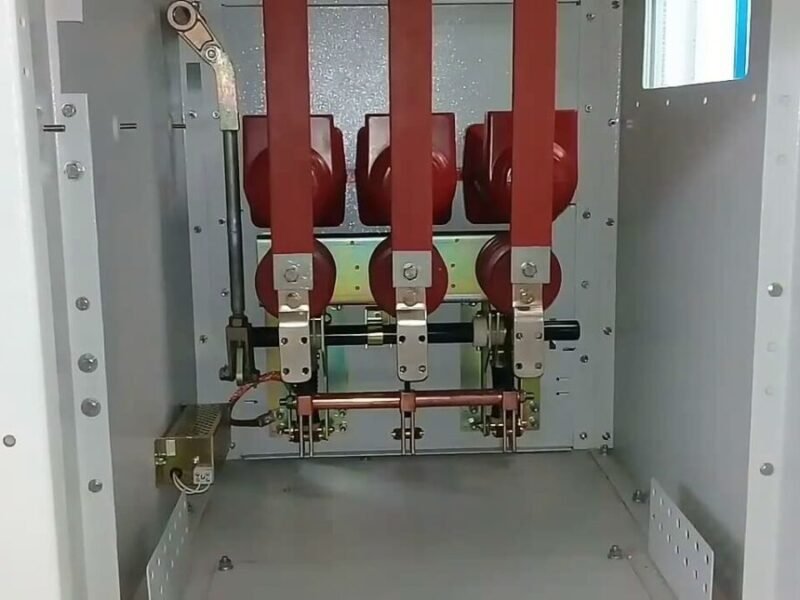
What Is an Earthing Switch and Why It Matters
An earthing switch is a device that connects a de-energised part of a switchgear panel to earth. It is used to make the equipment safe for work after the circuit breaker or isolator has been opened. It is one of the most important safety devices in medium voltage switchgear.
When a worker must enter a cable compartment or change a busbar, the earthing switch provides a visible and guaranteed connection to earth. This prevents the dangerous build-up of induced voltage and protects against accidental re-energisation.
Earthing Switch Working Principle
The earthing switch closes a solid metallic path between the live conductor and the earth busbar. When closed, any trapped charge or induced voltage is drained to earth immediately.
The switch has a rated short-circuit making capacity. If the switch is closed by mistake onto a live circuit, it must be able to close and hold against the full fault current without damage to the operator or the panel.
Interlocking is built into the design so the earthing switch can only be operated under safe conditions. This is why the earthing switch is mechanically linked to the circuit breaker and the access door.
Main Earthing Switch Types
| Type | Configuration | Typical Use | Key Feature |
|---|---|---|---|
| Three-position switch | Open / Closed / Earthed | RMU and ring networks | Combines isolator and earthing |
| Dedicated earthing switch | Separate device | MV switchgear panels | High making capacity |
| Fault-make earthing switch | Heavy duty | Substations, GIS | Closes onto fault current |
| High-speed earthing switch | Spring operated | GIS and cable compartments | Fast closing under fault |
| Transfer earthing switch | Two positions | Feeder transfer schemes | Earthing during transfer |
Where Earthing Switches Are Used
Earthing switches are fitted in cable compartments, on the busbar, and on the outgoing side of circuit breakers. In ring main units they are part of the three-position switch, which is the standard way to earth the cable before work.

In medium voltage panels, the earthing switch is often mounted in the cable compartment. This keeps the earth connection close to the point where a worker might need to work, which is the safest arrangement. The position indicator on the front of the panel shows clearly whether the switch is open, closed, or earthed.
In GIS, high-speed earthing switches are used to connect the line to earth quickly after a fault has been cleared. Their fast operation limits the duration of any abnormal voltage on the equipment. High-speed types are spring operated and can close within a few tens of milliseconds, which protects both the equipment and the operators.
The choice of location also depends on how the panel is maintained. Where cable testing is common, an earthing switch in the cable compartment makes the test connection simple and safe. Where busbar work is more frequent, an earthing arrangement on the busbar side is preferred.
Ratings and Selection Criteria
When selecting an earthing switch, the most important ratings are the rated short-time withstand current and the rated peak making current.

- Rated voltage: match the system voltage of the panel.
- Short-time withstand current: hold the fault current for the rated time.
- Peak making current: close onto the peak of the fault current safely.
- Mechanical endurance: number of operations expected over life.
- Interlocking: must prevent unsafe operation.
For a 33kV panel, a typical earthing switch is rated for 25kA to 31.5kA short-time withstand current and a corresponding making current. The exact value depends on the fault level of the substation.
Mechanical endurance is also important. A switch that is operated regularly needs a higher number of guaranteed operations. Always verify the making capacity, because this is the rating that protects the operator in the worst case.
Earthing Switch Operation and Safety
Operation of an earthing switch is only permitted when the associated circuit breaker is open. The interlocking system enforces this sequence.

Before closing the earthing switch, verify the circuit is isolated and that no live voltage is present. After closing, confirm the earth connection is complete with the position indicator.
Always follow the switchgear manufacturer’s operating instructions. A correct sequence is: open the breaker, open the isolator, close the earthing switch, and then verify with the panel indicator before work begins.
Testing and Maintenance
Earthing switches are tested for contact resistance, making capacity, and mechanical operation. Contact resistance is measured to detect loose or degraded contacts. A high or unstable reading points to a contact that needs cleaning or replacement.
Maintenance includes checking the contacts, verifying the interlock, and testing the operation mechanism. Following the switchgear maintenance plan keeps the earthing switch reliable over its full life. Operators should also check the position indicator and the door interlock before each work session to confirm that the switch is in the correct state.
FAQ
What is the purpose of an earthing switch?
It connects a de-energised part of the switchgear to earth so that work can be carried out safely.
Can an earthing switch be closed onto a live circuit?
No. It is only operated under interlocked safe conditions, and its making capacity is rated for the fault level.
What is the difference between an isolator and an earthing switch?
An isolator creates a visible break in the circuit, while an earthing switch connects the circuit to earth for safety.
Where is the earthing switch located in switchgear?
It is usually in the cable compartment or on the busbar, close to the point where work is performed.
What is a three-position switch?
It combines the open, closed, and earthed positions in one device, commonly used in ring main units.
Why is making capacity important?
It ensures the switch can close safely onto the full fault current if operated under fault conditions.
Electric-GS — Switchgear Manufacturer. Electric-GS is a switchgear manufacturer in Yueqing, China, building 33kV GIS, ring main units, and medium voltage switchgear with strict quality control and OEM/ODM support.
Contact us: email info@electric-gs.com or WhatsApp +86 135 8897 8050.
substation earthing design guide
33kV medium voltage switchgear buying guide
disconnector switch complete guide
MV switchgear maintenance plan
One thought