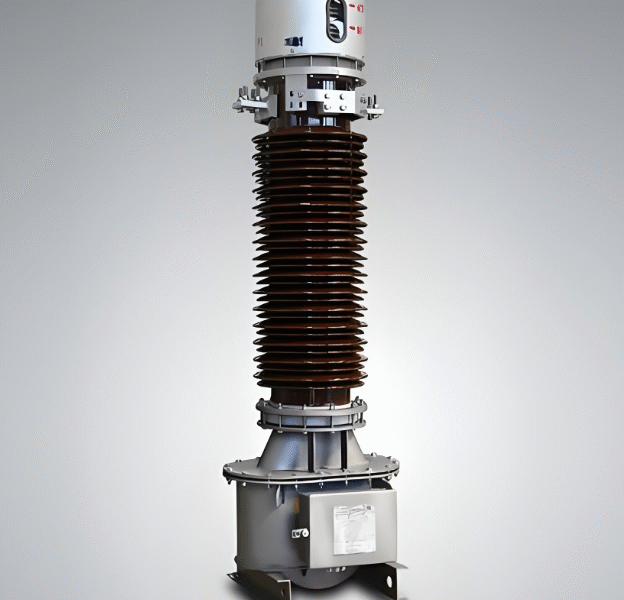

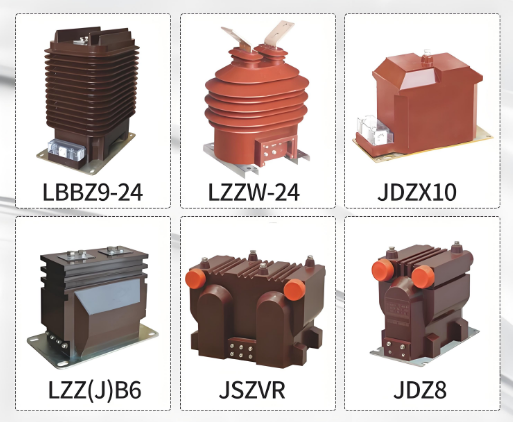
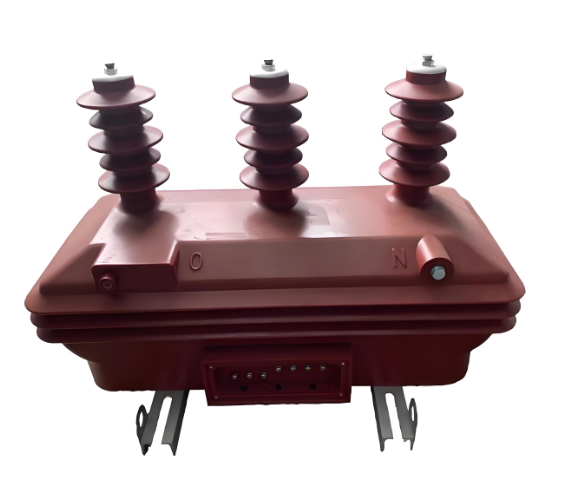
What Is an Instrument Transformer
An instrument transformer is a precision device that steps down high voltage and high current to safe, measurable values. It feeds meters, relays, and control units in switchgear panels. There are two main families: the current transformer (CT) and the voltage transformer (VT, also called PT).
Without these units, protection relays and energy meters could not work safely on a 11 kV or 33 kV network. The transformer isolates the secondary equipment from the primary circuit, so operators and instruments stay protected.
Current Transformer (CT) Basics
A current transformer steps down primary current to a standard secondary value. The most common secondary rating is 1 A or 5 A. The primary is connected in series with the power circuit, and the secondary feeds the measuring or protection device.
The CT ratio is written as two numbers, for example 100/5 A or 600/1 A. Choose the ratio so that the full load current sits in the accurate measuring range of the CT.
CTs are built in several forms. Ring or window CTs slide over the cable or busbar. Bar primary CTs use an integrated bar as the primary conductor. Wound primary CTs have a dedicated winding, and are used for lower currents. The correct form depends on the panel design and the primary current level.
The burden is the total load connected to the secondary, including wires, relays, and meters. A CT must deliver its accuracy class at the rated burden. If the actual burden is far higher or lower than rated, accuracy degrades.
Voltage Transformer (VT) Basics
A voltage transformer steps down primary voltage to a standard secondary value, usually 100 V or 110 V. It is connected in parallel across the primary circuit, like a normal power transformer. VTs feed voltage inputs to relays, meters, and synchronizing devices.
VT accuracy matters for revenue metering and protection. A poorly selected VT can cause wrong voltage readings and incorrect relay settings.
Key Differences Between CT and VT
| Feature | Current Transformer (CT) | Voltage Transformer (VT) |
|---|---|---|
| Connection | Series with line | Parallel across line |
| Input | High current | High voltage |
| Secondary | 1 A or 5 A | 100 V or 110 V |
| Output | Near short circuit | Near open circuit |
| Main use | Metering and protection | Metering and protection |
Accuracy Classes Explained
Accuracy class tells you how precisely the transformer reproduces the primary value. Metering CTs use classes such as 0.2, 0.2S, and 0.5. Protection CTs use classes such as 5P10 and 5P20, which describe the accuracy limit factor.
- 0.2 / 0.2S — high accuracy, for revenue metering.
- 0.5 — good accuracy, for general metering.
- 5P10 / 5P20 — protection class, holds accuracy up to 10 or 20 times rated current.
- VT classes — 0.2, 0.5, and 3P for protection use.
How to Select Current and Voltage Transformers
Selecting a Current Transformer
- Determine the maximum load current and the fault current level.
- Pick a CT ratio that covers normal load with margin.
- Choose metering class or protection class based on the device it feeds.
- Check the rated burden (VA) matches the connected load.
- Verify the CT can pass the short circuit current without saturation.
Always size the CT for the actual cable or busbar it mounts on. An oversized CT gives poor low-load accuracy, while an undersized CT can saturate under fault. For metering, select a class 0.2 or 0.5 CT with a ratio close to the normal load. For protection, select a 5P10 or 5P20 CT sized for the maximum fault current. Many switchgear panels use two CTs on each phase, one for metering and one for protection.
Selecting a Voltage Transformer
- Match the primary voltage to the system phase-to-phase or phase-to-earth rating.
- Select secondary voltage, usually 100 V for line-to-line systems.
- Choose the accuracy class for the metering or protection duty.
- Check the rated burden and the connection group.
- For earthed systems, confirm the VT insulation level.
VTs can be single pole or double pole, and can be connected star-star, star-delta, or with an open delta for residual voltage detection. The open delta connection is common in protection schemes to detect earth faults.
Wiring, Safety and Common Mistakes
- Never open the secondary circuit of a CT while it is energised — dangerous overvoltage can occur.
- Always ground the CT secondary at one point.
- Keep secondary wiring short and correctly polarised.
- Use shorting blocks before removing a CT from service.
- Check VT fuses or breakers on the primary side.
The most common error is selecting a CT only by ratio and ignoring burden and accuracy class. The second is connecting the CT with reversed polarity, which causes wrong protection operation. The third is using a metering CT for protection duty, which saturates during faults. Always verify the short circuit withstand rating, not just the normal current rating.
FAQ
What is the difference between a CT and a VT?
A CT steps down current and is connected in series. A VT steps down voltage and is connected in parallel.
What is the standard secondary output of a CT?
Most CTs provide 1 A or 5 A at rated primary current.
Why can you not open a CT secondary circuit?
Opening the secondary can create a dangerous high voltage and damage the insulation or equipment.
What does 5P10 mean on a CT?
It is a protection class. The CT stays accurate up to 10 times its rated current.
Are instrument transformers used in every switchgear panel?
Yes. MV switchgear panels use CTs and VTs to feed relays, meters, and control circuits.
Does Electric-GS supply current and voltage transformers?
Yes. Electric-GS supplies CTs and VTs for MV switchgear projects, with test certificates and OEM support.
Electric-GS — Your Switchgear and Instrument Transformer OEM Partner. Electric-GS is a manufacturer based in Yueqing, China, supplying MV switchgear, current transformers, voltage transformers, and ring main units. Our factory supports OEM and ODM projects with type tests and reliable delivery.
Contact us for a tailored quotation: email info@electric-gs.com or WhatsApp +86 135 8897 8050.
medium voltage switchgear buying guide
MV switchgear maintenance plan
transformer differential protection guide
motor control center design guide
substation earthing design guide