A transfer failure costs more than a breaker failure. When the utility feed drops, automatic transfer switchgear has to detect the loss, confirm it, start the standby source and close the alternate breaker within seconds. If any step is under-specified, the load stays dark and the generator runs for nothing. These six checks are what we verify on every ATS panel before dispatch.
How an Automatic Transfer Switch Panel Works
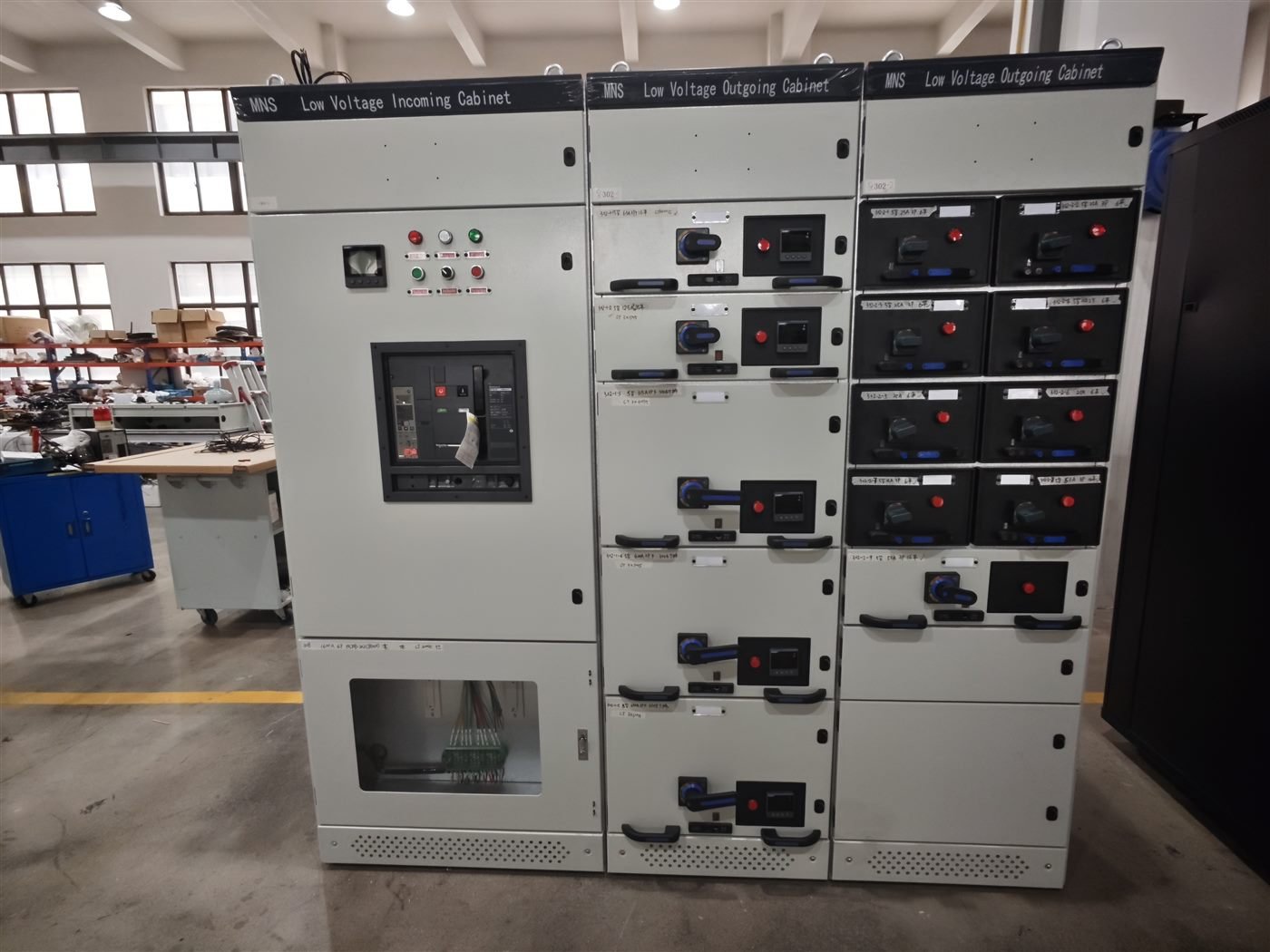
An ATS panel is not one device. It is a small system: two incoming breakers or a breaker plus a contactor, a controller, a voltage sensing circuit and an interlock that makes it physically impossible to close both sources at once. The controller watches voltage, frequency and phase sequence on both feeds. When the main feed stays outside its window longer than the set delay, it signals the generator to start, waits for rated voltage and frequency, opens the main breaker and closes the alternate one.
Three numbers define the whole design: the transfer time your load can tolerate, the short-circuit current each source can deliver, and the number of transfers per year. A three-pole panel keeps the neutral solid; a four-pole panel switches it, and that single choice changes the earthing design for the whole building.
6 Checks Before You Order an ATS Panel
- Match transfer time to the load, not to the catalogue. A resistive or lighting load rides through 2 s to 5 s easily. IT racks, VFD-driven pumps and hospital imaging equipment may need closed transition or a UPS bridge. Write the allowed interruption in milliseconds into the specification before you compare prices.
- Check breaking capacity from both sources. The ATS must interrupt the larger of the two fault currents, which is often the generator contribution rather than the utility one. A panel sized only on the utility fault level will fail the first generator-side test.
- Choose the transition type deliberately. Open transition is simple and cheap. Closed transition keeps the load alive but needs synchronising check relays and a short parallel period. Soft loading spreads the step change over several seconds. Each choice changes the controller, the interlocks and the price.
- Read the controller logic, not just the brand. Confirm the voltage and frequency windows, the start delay, the return-transfer delay, the cool-down timer and whether the neutral position is centre-off or fixed to one source. Ask for the parameter list in writing.
- Demand a real interlock, plus a status signal. A mechanical interlock plus electrically interlocked contactors is the normal arrangement. Both-source-closed is the failure that destroys a generator, so add a feedback contact wired to the building management system.
- Verify the enclosure and the cable space. Check IP rating for the environment, ambient temperature, altitude derating, and whether the terminals accept the cable sizes the site actually uses. Many ATS failures at commissioning are lugs that will not take a 120 mm² cable.
Transition Types and Timing Compared
Timing is the part buyers most often get wrong, because the catalogue figure is measured with an ideal generator.
| Transition type | Typical interruption | Best for | Watch out for |
|---|---|---|---|
| Open transition (break-before-make) | 0.5 s – 10 s | Lighting, pumps, general building loads | Motors coast down and restart with high inrush |
| Closed transition (make-before-break) | Under 100 ms | Data rooms, process lines, hospitals | Needs sync check relays and a parallel timer |
| Soft loading transfer | 2 s – 10 s, ramped | Large generators, high step loads | More complex controller tuning |
Add generator start and stabilising time to any figure above. In practice a 500 kVA diesel set needs 8 s to 15 s from start signal to ready-to-load, so the real outage is generator time plus transfer time, not transfer time alone.
Testing and Commissioning Checks
- Simulate a mains failure with the load connected and record the actual transfer time.
- Confirm the generator reaches rated voltage and frequency before the ATS closes.
- Test the return transfer with a deliberate cool-down period and observe load steps.
- Verify the interlock by attempting both close commands at once; nothing should move.
- Check controller settings against the approved parameter list and save a copy on site.
- Thermal-scan terminals and busbars after one hour at rated load.
Record the measured figure, not the catalogue figure. A panel that transfers in 12 s because the generator start signal was wired to the wrong terminal looks identical to a fast one on paper, and only the test tells you which you own. Keep the printed parameter list inside the door pocket.
An ATS is only as good as the maintenance behind it. Pair the commissioning record with a routine infrared thermography check and the contact and mechanism inspection in our 10-step MV switchgear maintenance plan. Standby systems that run in parallel with generators also need the load-sharing logic described in the generator paralleling switchgear guide, and container projects should read the BESS switchgear design notes before fixing the ATS position in the single-line diagram.
FAQ
What is the difference between ATS and manual transfer switch?
An automatic transfer switchgear starts the standby source and transfers without an operator. A manual switch needs a person on site, which is acceptable only where a long outage is tolerable.
How long should an ATS take to transfer?
Open transition panels typically transfer in 0.5 s to 10 s after the generator is ready. Add 8 s to 15 s for a diesel generator to start and stabilise.
Can one ATS feed two different voltage systems?
No. Both sources must share the same voltage, frequency and phase rotation. Mixed systems need a transformer or two separate transfer schemes.
Does an ATS need a neutral position?
Four-pole ATS panels usually switch to a centre-off neutral to avoid parallel neutral paths. Three-pole panels keep the neutral solid, which is fine when both sources share one earthing system.
How often should an ATS be tested?
Run a full transfer test every six months and a no-load logic test every quarter. After any controller change, repeat the full test before returning the panel to service.
About Electric-GS
Electric-GS is an OEM/ODM switchgear factory in Yueqing, Zhejiang, China. We build RMU, GIS, MV and LV switchgear, automatic transfer panels, cable boxes and packaged substations, and we assemble ATS panels with interlocked breakers, configurable controllers and site-specific cable arrangements. Send your single-line diagram and load list to info@electric-gs.com or WhatsApp +86 135 8897 8050 for a specification review. Product ranges are on electricgs.com, and Chinese technical notes are on electric-cn.com.